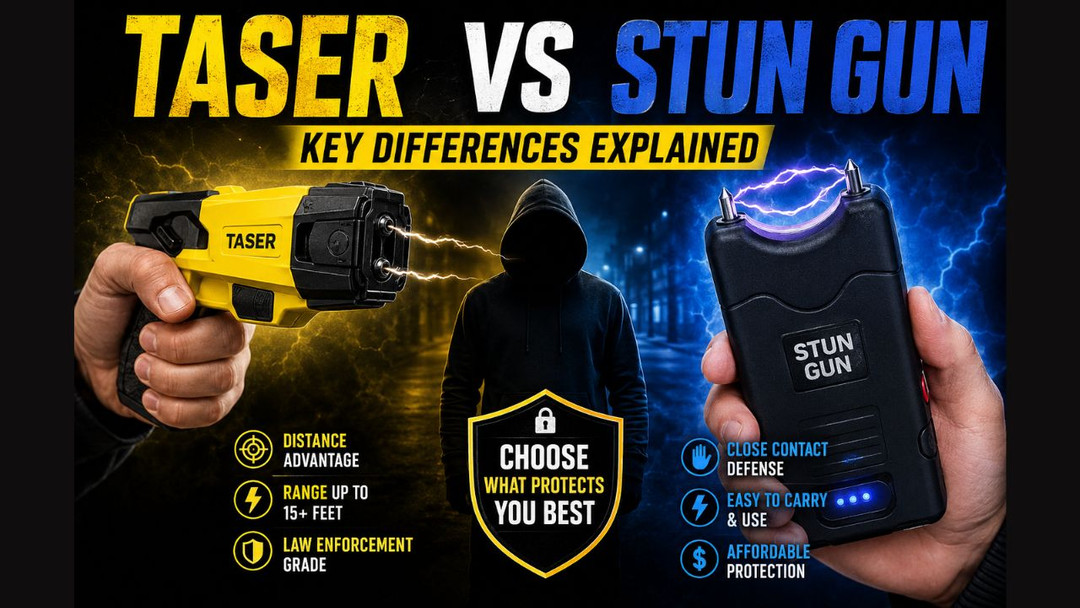
Taser vs Stun Gun: Key Differences Explained
Ever noticed how people use the words taser and stun gun like they mean the same thing?
That confusion is actually very common—and a bit risky too.
Because when it comes to personal safety, choosing the wrong device or not understanding how it works can make a big difference in a real emergency. The taser versus stun gun debate isn’t just about technical features—it’s about how you protect yourself in real life situations where every second matters.
So what really separates them? Why does one work from a distance while the other needs direct contact? And more importantly, which one should you actually trust for self-defense?
Let’s break it down in a clear, practical way.
What Is a Taser?
A taser is a ranged electronic self-defense device designed to stop a threat from a distance. It fires small probes connected to wires that attach to the attacker and send an electrical pulse.
This pulse temporarily interferes with the nervous system, causing muscle disruption and loss of control.
Simple way to understand it:
A taser is like a “remote control stop button” for dangerous situations.
Key points:
- Works from a distance (range varies by model)
- Fires two small probes
- Causes temporary muscle control loss
- Often used by law enforcement
In the taser versus stun gun comparison, tasers are clearly built for distance safety.
What Is a Stun Gun?
A stun gun is a handheld self-defense device that works only through direct physical contact. It delivers a high-voltage electric shock when pressed against an attacker.
Unlike tasers, it does not fire anything—it requires close proximity.
Simple way to understand it:
A stun gun is a “close-contact defense tool” meant for instant reaction.
Key points:
- Requires direct contact
- Delivers electric shock instantly
- Compact and easy to carry
- Designed for personal protection
In the taser versus stun gun discussion, stun guns are all about close-range defense.
Taser Versus Stun Gun: Key Differences
Now let’s compare both clearly.
1. Range of Use
- Taser: Works from a distance
- Stun Gun: Requires contact
2. How They Work
- Taser: Fires probes with wires
- Stun Gun: Direct electric contact
3. Purpose
- Taser: Control threat before contact
- Stun Gun: Defend during close attack
4. Safety Distance
- Taser: Safer because of distance
- Stun Gun: Riskier due to close contact
5. Ease of Use
- Taser: Needs some awareness and aim
- Stun Gun: Very simple to use
6. Cost
- Taser: Usually expensive
- Stun Gun: Budget-friendly
Which One Is More Effective?
There is no single winner in the taser versus stun gun comparison.
Effectiveness depends on the situation:
- If you are at a distance → taser is more effective
- If attacker is already close → stun gun is more useful
Real truth:
The best tool is the one that matches your real-life risk situation, not just features.
Real-Life Situations
Situation 1: Walking Alone at Night
A taser can help you stop a threat before they reach you.
Situation 2: Sudden Close Attack
A stun gun becomes more practical because there’s no time for distance.
Situation 3: Home Protection
A stun gun is often easier to access quickly indoors.
This shows why the taser versus stun gun debate depends heavily on context.
Legal Considerations
Before choosing between a taser versus stun gun, legality is very important.
- Some countries restrict tasers heavily
- Some regions regulate stun guns too
- Laws vary depending on location
Always check local rules before buying or carrying any device.
Pros and Cons
Taser Advantages
- Long-distance protection
- Reduces physical risk
- Effective in open spaces
Taser Disadvantages
- Expensive
- Requires accuracy
- Legal restrictions in many areas
Stun Gun Advantages
- Easy to carry
- Simple operation
- Affordable
- Fast activation
Stun Gun Disadvantages
- Requires close contact
- Risky in open situations
- Limited range
Common Mistakes People Make
Many people misunderstand the taser versus stun gun topic and make mistakes like:
- Thinking both are identical
- Ignoring legal restrictions
- Buying without understanding range
- Assuming higher voltage means better safety
Understanding basics prevents poor choices.
Safety Tips
No matter which one you choose:
- Always carry responsibly
- Don’t use unless necessary
- Keep it accessible but secure
- Learn basic operation beforehand
- Store safely away from children
Self-defense tools only work when used correctly.
Which One Should You Choose?
Ask yourself:
- Do I need distance protection? → Choose taser
- Do I want simple close defense? → Choose stun gun
- Do I want budget-friendly safety? → Stun gun wins
- Do I want advanced control? → Taser wins
The right choice in the taser versus stun gun debate depends on your lifestyle.
Why Stun Guns Are More Popular
Many people prefer stun guns today because:
- They are compact
- Easy to use instantly
- More affordable
- Suitable for everyday carry
For general personal safety, they are often more practical.
FAQ: Taser Versus Stun Gun
1. Are tasers and stun guns the same?
No, tasers work from a distance while stun guns require contact.
2. Which is better for self-defense?
It depends on your situation and environment.
3. Are stun guns legal?
Laws vary by country and region.
4. Can a stun gun stop an attacker?
Yes, it can temporarily disable or slow an attacker.
5. Is a taser stronger than a stun gun?
Tasers are designed for longer-range incapacitation.
6. What is the main difference?
Range—tasers work from distance, stun guns need contact.
Conclusion
The taser versus stun gun comparison is not about which one is “better,” but which one is right for your real-life situation.
If you need distance and controlled stopping power, a taser may be suitable. If you want simple, fast, and close-range protection, a stun gun is often the more practical choice.
In the end, personal safety is not just about tools—it’s about awareness, preparation, and choosing wisely.