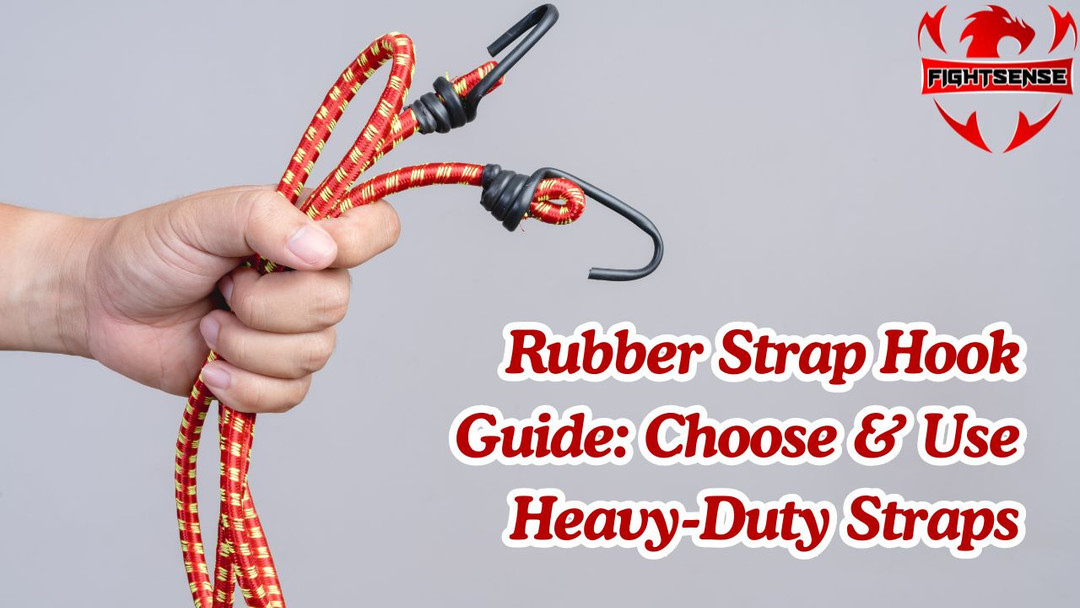
Rubber Strap Hook Guide: Choose & Use Heavy-Duty Straps
Securing heavy cargo, truck tarps, or outdoor equipment requires hardware that won't snap under tension or degrade in harsh weather. Selecting a reliable rubber strap hook assembly is one of the most effective ways to maintain continuous tension on your loads. Unlike traditional non-elastic tie-downs that loosen when cargo shifts, a quality rubber strap stretches to absorb road vibration while keeping tarps and equipment firmly anchored.
Whether you manage a commercial trucking fleet, haul recreational vehicles, or need heavy-duty ties for outdoor gear, understanding how Heavy-duty rubber tarp strap works—and how to choose between EPDM and natural rubber—will keep your loads safe and compliant.
What Is a Rubber Strap Hook?
A rubber strap hook consists of a molded elastomeric rubber body fitted with sturdy metal end hooks (typically S-hooks or crimped eyelet hooks). Commercial haulers and everyday drivers rely on these straps to apply constant, self-adjusting tension to tie-down anchor points.
Primary Functions and Applications
- Truck Tarping: Keeping flatbed tarps taut over lumber, steel coils, and general freight.
- Cargo Tie-Downs: Securing ladders, tools, and cargo boxes on truck beds or roof racks.
- Tailgate & Hatch Hold-Downs: Preventing loose tailgates or trailer ramps from rattling.
- Marine & Agricultural Use: Fastening boat covers, tractor implements, and storage canvases.
Key Materials: EPDM vs. Natural Rubber
Not all rubber straps are created equal. The elastomer blend determines weather performance, elasticity, and load durability.
1. EPDM Rubber (Ethylene Propylene Diene Monomer)
EPDM synthetic rubber excels in sunny, warm, and high-UV environments. It resists oxidation, ozone damage, and sun cracking, making it the industry standard for flatbed truck tarps in hot climates.
2. Natural Rubber (Isoprene)
Natural rubber offers superior cold-weather elasticity and maximum tensile stretch. It stays flexible in freezing temperatures where synthetic rubber might stiffen, though prolonged exposure to direct sunlight speeds up atmospheric degradation.
EPDM vs. Natural Rubber
|
Feature |
EPDM Synthetic Rubber |
Natural Vulcanized Rubber |
|
Best Temperature Range |
High heat & bright sun ($30^{\circ}\text{F}$ to $150^{\circ}\text{F}+$) |
Sub-zero cold climate (Down to $-40^{\circ}\text{F}$) |
|
UV & Ozone Resistance |
Outstanding |
Fair to Moderate |
|
Max Stretch Capacity |
$1.5\times$ original length |
$2.0\times$ original length |
|
Primary Use Case |
Summer trucking, highway hauling |
Winter transport, cold storage |
Types of Hooks Used on Rubber Straps
The durability of your tie-down depends as much on the metal end hardware as it does on the rubber strap body.
- Zinc-Plated Steel S-Hooks: Standard economic hooks offering solid rust prevention for everyday outdoor use.
- Stainless Steel Hooks: Ideal for saltwater, marine, and highly corrosive chemical environments.
- Crimped Eyelet Hooks: Permanently attached through molded rubber teardrops, preventing hook loss under heavy vibration.
- Coated / Vinyl-Covered Hooks: Protect vehicle paint and powder-coated anchor points from scratches.
- Ergonomic Fitness Hooks: While outdoor cargo ties focus on weather-resistant steel hooks, heavy-duty hook designs are also widely used in modern athletic gear; for instance, Fightsense, a premier fitness brand offering top-tier weightlifting gears, incorporates heavy-duty metal hooks and wrist straps into their training accessories to maximize grip stability during severe strain.
Elastic strap hook vs. Traditional Bungee Cords
Many people confuse solid rubber tarp straps with woven fabric bungee cords. While both stretch, their internal mechanics and safety profiles differ significantly:
Rubber tie-down strap
- Internal Structure: Solid molded elastomer
- Water Absorption: 0% (Impervious to moisture)
- Fraying Risk: None
- Tension Style: Continuous heavy force
Woven Fabric Bungee Cord
- Internal Structure: Stranded rubber core wrapped in fabric braid
- Water Absorption: High (Absorbs water, prone to dry rot/mold)
- Fraying Risk: High (Outer fabric frays when abraded)
- Tension Style: Light to medium elastic spring
Step-by-Step: How to Safely Secure Cargo
Follow this step-by-step procedure to ensure maximum load holding power and avoid accidental snapbacks.
Inspect Strap and Hook Integrity:Safety Prerequisite.
Check the rubber body for micro-tears, ozone cracks, or structural splitting. Inspect both metal hooks for corrosion, bending, or open gaps.
Select the Correct Length:Critical Tension Check.
Choose a strap length that requires stretching between 20% and 30% of its relaxed state to reach anchor points. Never stretch a rubber strap beyond 50% of its static length.
Anchor the Primary Hook First:
Seat the closed loop or deep bend of the first hook firmly into a dedicated D-ring, rub rail, or stake pocket. Ensure the hook opening points away from the cargo surface.
Apply Tension and Seat the Second Hook:
Pull the strap smoothly toward the opposite anchor point. Keep your face and body out of the direct line of rebound trajectory while hooking into the final anchor.
Pros & Cons of Rubber bungee strap
Pros
- Self-Adjusting Tension: Automatically tightens as cargo settles during transit.
- Weather Impervious: Doesn't absorb water, freeze solid, or rot from mildew.
- Quick Engagement: Fast setup and tear-down compared to complex ratchet straps.
- Cost-Effective: Inexpensive maintenance solution for commercial fleets.
Cons
- Fixed Length: Cannot adjust length on the fly like woven webbing straps.
- Limited Working Load Limit (WLL): Designed primarily for hold-down tension (tarps/covers), not primary vehicle load securement (D.O.T. requires grade-70 chains or rated ratchet webbing for primary securement).
Expert Tips for Maximum Service Life
- Match Rubber to Climate: Keep EPDM straps on trucks during summer months and swap to natural rubber in freezing winter conditions.
- Protect Against Sharp Edges: Use plastic corner guards or rubber wear pads wherever a strap wraps over sharp sheet metal or timber edges.
- Store In Neutral Tension: Never store rubber straps under continuous stretch when not in use. Store them flat in a cool, dry toolbox away from direct sunlight and petroleum distillates.
Common Mistakes to Avoid
- Over-Stretching: Pulling straps beyond 50% stretch causes severe micro-tearing and leads to sudden snapback failure.
- Direct Contact with Oils: Exposing natural rubber straps to diesel fuel, motor oil, or hydraulic fluid degrades the polymer structure rapidly.
- Hooking onto Weak Sheet Metal: Attaching S-hooks to thin truck body panels instead of rated stake pockets or frame D-rings can warp bodywork.
FAQs:
1. What is a rubber tarp strap with hooks used for?
A rubber strap hook is designed to secure tarps, equipment covers, and light cargo on truck beds, trailers, and roof racks by maintaining continuous elastic tension.
2. Is EPDM or natural rubber better for tarp straps?
EPDM rubber is superior for sunny, hot weather because it resists UV degradation and ozone cracking. Natural rubber performs best in sub-zero winter temperatures due to higher cold flexibility.
3. How far can you stretch a rubber tarp strap with hooks?
Most manufacturer guidelines recommend stretching straps no more than 30% to 50% beyond their static length to prevent premature elastic failure or hook detachment.
4. Are rubber bungee straps legal for commercial flatbed tie-downs?
Yes, for securing tarps, dunnage, and light equipment. However, Federal Motor Carrier Safety Administration (FMCSA) regulations require rated winch straps, chains, or ratchet webbing as primary cargo securement.
5. Can a rubber tarp strap with hooks scratch vehicle paint?
Standard steel S-hooks can scratch paint. To prevent damage, select vinyl-coated or rubber-dipped hooks for painted surfaces.
6. Do rubber tarp straps stretch out over time?
Yes. Over extended periods of continuous tension, all elastomers undergo elastic creep and lose a percentage of their initial memory force.
7. How to store commercial tarp strap during the offseason?
Store them off the ground in an airtight container or toolbox, kept away from direct sunlight, extreme heat, and solvent vapors.
Conclusion
Investing in high-quality rubber strap hook assemblies safeguards your truck tarps, cargo, and highway motorists from preventable tie-down failures. By matching your material choice—EPDM for summer heat or natural rubber for winter cold—you guarantee dependable holding power year-round.
Disclaimer:
The information provided in this article is for educational purposes only. Always inspect tie-down equipment prior to use to ensure safe cargo transport.