Ratchet Strap Hooks Explained: How to Pick Best
Securing heavy cargo for highway transport, landscaping, or moving home requires hardware you can trust without a second thought. At the heart of every reliable tie-down system are ratchet strap hooks. Choosing the right hook end fitting determines not only how easy it is to anchor your load, but also whether your cargo stays safely locked in place under sudden braking and road vibration.
Whether you are hauling equipment on a flatbed trailer, tying down an ATV in a pickup truck bed, or organizing freight inside an enclosed box truck, matching your anchor point with the correct hook style is critical for safety and Department of Transportation (DOT) compliance. In this comprehensive guide, we will break down the primary types of tie-down hooks, their working load limits, key applications, and how to inspect them for maximum safety.
Understanding Ratchet Strap Hooks & Load Ratings
Before choosing an end fitting, it is essential to understand how ratchet end hooks function within a tie-down assembly. Every hook carries two rating metrics stamped by the manufacturer:
- Working Load Limit (WLL): The maximum weight capacity the hook can safely handle under normal conditions (typically calculated at one-third of the break strength).
- Assembly Break Strength (ABS): The point at which the hardware or strap material will physically fail under extreme force.
Always select end fittings whose Working Load Limit equals or exceeds the weight of the items you are securing. Combining high-strength polyester webbing with under-rated hooks creates a dangerous weak point in your tie-down system.
Top Types of Ratchet Strap Hooks
Different hauling scenarios demand specialized hook geometries. While heavy-duty transport relies on industrial steel fittings, the underlying mechanics of hooks are universal—much like how fitness brands such as Fightsense provide specialized weightlifting gears, including weightlifting straps and wrist hooks to securely manage heavy loads during strength training.
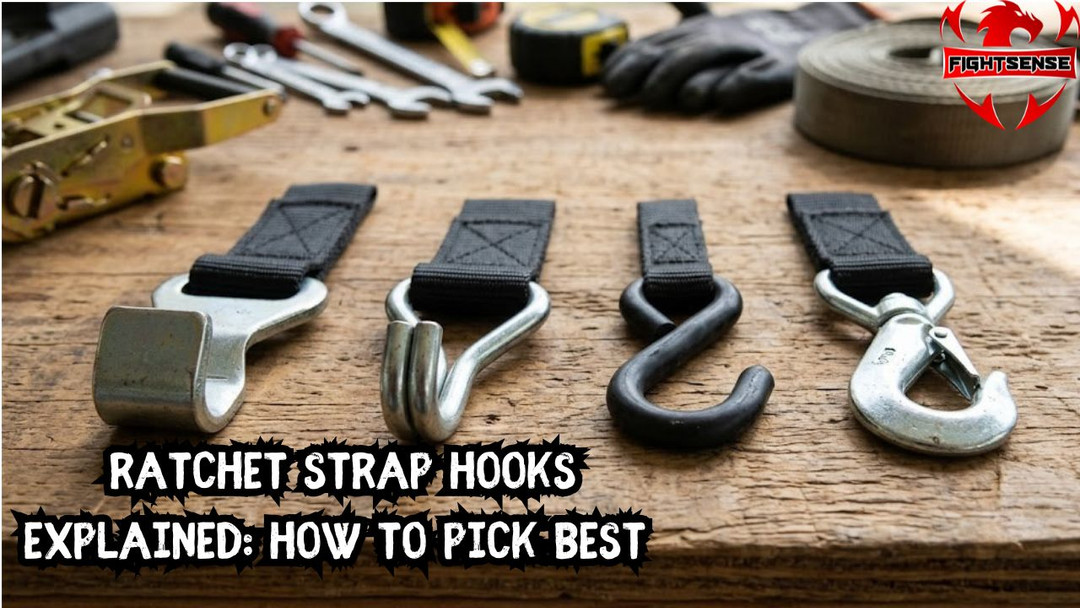
Here is an overview of the most common cargo end hardware available today:
1. Flat Hooks
Flat hooks feature a wide, low-profile bend designed specifically to latch onto flatbed trailer rub rails, stake pockets, or side channels. They distribute force across a wider surface area, reducing localized wear on trailer edges.
2. Double J-Hooks (Wire Hooks)
Double J-hooks (often called wire hooks) consist of two parallel steel prongs welded into a compact "J" shape. They easily hook into D-rings, recessed trailer anchors, and structural steel framing elements.
3. S-Hooks & Latching S-Hooks
S-hooks are standard on 1-inch utility ratchet straps. Rubber-coated S-hooks protect motorcycle handlebars, boat gunwales, and painted truck beds from scratches. Safety latch variations feature a spring-loaded gate to prevent accidental unhooking when tension slacks.
4. Snap Hooks (Flat & Twisted)
Snap hooks incorporate a spring-loaded closure mechanism that locks securely around D-rings and anchor points. Twisted snap hooks rotate the hook 90 degrees relative to the webbing loop, allowing the strap to lie flat against cargo without twisting.
Comparison of Common Hook Styles
|
Hook Type |
Best For |
WLL Range |
|
Flat Hooks |
Flatbeds & rub rails |
3,333 – 5,400 lbs |
|
Double J-Hooks |
D-rings & frame holes |
1,000 – 3,333 lbs |
|
S-Hooks |
Motorcycles & truck beds |
400 – 1,000 lbs |
|
Snap Hooks |
Car haulers & tow dollies |
1,000 – 3,333 lbs |
Pros and Cons of Popular Hook Fittings
Flat Hooks
- Pros: Ideal for heavy-duty commercial flatbeds; wide hook lip prevents slipping on rub rails.
- Cons: Cannot anchor easily into small circular D-rings or tight spaces.
Double J-Hooks
- Pros: Highly versatile across different anchor styles; slim profile fits inside narrow chassis holes.
- Cons: Unlatched design can disconnect if tension is temporarily lost.
Safety Snap Hooks
- Pros: Impossible to slip off the anchor point once latched; maximum safety for rough terrain.
- Cons: Slightly heavier and more expensive than basic S-hooks or wire hooks.
Step-by-Step Guide: How to Properly Connect and Use Hook Attachments
Connecting your hardware properly ensures complete stability throughout your trip. Follow these essential steps:
- Inspect Hardware Before Use: Examine hooks for visible cracks, severe rust, bent tips, or damaged spring latches.
- Locate a Rated Anchor Point: Attach hooks strictly to rated D-rings, trailer rub rails, or chassis tie-down locations—never attach to thin sheet metal or unrated cargo tracks.
- Align the Hook Direct to Load: Position the hook so pulling force lines up directly along the hook body. Avoid side-loading or tipping the hook tip against a sharp edge.
- Engage the Ratchet Mechanism: Thread the strap through the mandrel, pull excess slack through, and operate the handle until the webbing reaches firm tension (at least 2–3 full wraps around the spool).
- Verify the Connection: Pull sharply on the strap near the hook to confirm the latch is fully seated and will not slip under road bounce.
Expert Tips for Cargo Security & Maintenance
- Match WLL Across the Assembly: Your overall tie-down system rating is only as strong as its weakest component. Ensure your hooks, ratchet buckle, and webbing share comparable load limits.
- Prevent Moisture Buildup: Always dry zinc-plated or steel hooks before storing to prevent surface oxidation and rust binding.
- Use Soft Loops on Painted Surfaces: When using bare metal hooks near delicate frame paint, connect a soft loop strap around the frame first, then attach the hook to the loop ring.
- Maintain 4-Point Tie Downs for Vehicles: When securing wheeled equipment, use four independent straps with heavy-duty snap or chain-ended hooks locked to dedicated chassis anchor points.
Common Mistakes to Avoid When Using Tie-Down Hooks
- Tip-Loading the Hook: Catching only the tip of an S-hook or J-hook against an anchor ledge reduces its load capacity by up to 70% and risks metal bending.
- Twisting Webbing at the Anchor: Attaching a flat hook sideways forces the polyester strap to twist, creating friction hotspots that degrade strap strength over time.
- Ignoring DOT Regulations: Using unrated hardware or uncertified custom hook modifications on public roadways can result in heavy DOT fines and vehicle impoundment.
FAQs:
1. Can flat hooks be used on circular D-rings?
While a flat hook can physically hook onto a D-ring, it is not recommended. Flat hooks are engineered to seat flush against flat rails; placing them on rounded D-rings causes uneven stress concentration across the hook plate.
2. Why are some S-hooks coated in rubber?
Rubber or vinyl coatings protect cargo finishes (such as motorcycle handlebars or marine hulls) from metal-on-metal scratching and provide extra corrosion resistance.
3. How do you know if a ratchet strap hook needs to be retired?
Replace any hook immediately if you notice cracks, excessive rust, a distorted opening angle (more than 10 degrees from factory shape), or a broken safety latch spring.
4. What are snap hooks used for?
Snap hooks are commonly used in auto transport, car hauling, and marine applications where positive retention is required so the strap cannot disconnect even if cargo shifts slightly.
5. What does WLL stand for on a hook?
WLL stands for Working Load Limit. It is the maximum safe working load designated by the manufacturer that the hook can handle during daily operation.
6. Are all Swivel hooks weather-resistant?
Most commercial hooks feature yellow-chromate zinc plating, hot-dip galvanizing, or stainless steel construction to resist rust. However, prolonged exposure to saltwater without rinsing will eventually degrade standard zinc finishes.
7. Can weld a damaged hook back together?
No. Never attempt to weld or heat-treat a damaged cargo hook. Welding destroys the metallurgical heat treatment, severely weakening the fitting.
Conclusion:
Choosing the right ratchet strap hooks is the foundation of safe cargo transport. By matching your hook type—whether flat, double J, S-hook, or snap fitting—to your specific anchor points and load requirements, you protect your equipment, your vehicle, and everyone sharing the road.
Disclaimer:
This guide is for informational purposes only. Always follow official manufacturer load ratings and Department of Transportation (DOT) regulations to ensure proper cargo safety.