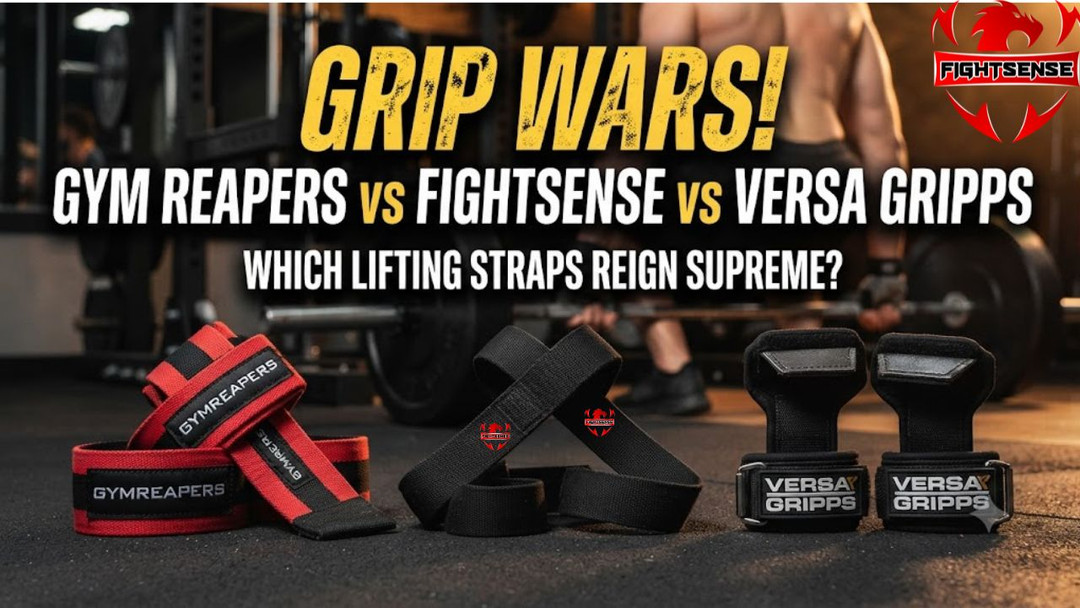
Gym Reaper Wrist Straps: FightSense vs Versa Gripps
Choosing the right lifting straps can make a noticeable difference when your grip starts limiting your training. Gym reaper wrist straps are a popular option for deadlifts, rows, shrugs, and other pulling exercises. However, traditional lifting straps are not the only choice.
Today, lifters can also choose padded straps, lifting grips, and other grip-support equipment. FightSense and Versa Gripps offer alternatives with different designs and use cases.
So, which option makes the most sense for your training?
This guide compares Gymreapers, FightSense, and Versa Gripps by design, comfort, grip support, ease of use, durability, and overall value. It also explains how lifting straps work, when to use them, and the mistakes that can reduce their effectiveness.
What Are Gym Reaper Wrist Straps?
Gym Reaper wrist straps generally refer to Gymreapers lifting straps, which are traditional straps designed to help secure your hands to a bar during pulling movements.
Gymreapers currently lists its standard lifting straps as 18-inch cotton straps with neoprene padding. The company says they are designed for powerlifting, bodybuilding, cross-training, and other weightlifting activities. The product also carries a lifetime replacement guarantee.
The important distinction is that lifting straps are primarily designed to assist grip during pulling exercises. They are not the same as wrist wraps.
Wrist wraps are mainly used to provide wrist stability during pressing movements. Lifting straps, on the other hand, connect your hands more securely to the bar when grip fatigue becomes the limiting factor.
Gymreapers Strap Features
The standard Gymreapers lifting straps offer:
- 18-inch strap length
- Cotton construction
- Neoprene wrist padding
- Traditional lasso-style design
- Two straps per package
- Pulling-movement support
- Lifetime replacement guarantee
Independent testing has also highlighted their affordability, comfort, and lifetime guarantee, while noting that the 18-inch length may feel short for some lifters.
Why Do Lifters Use Wrist Straps?
The main reason to use lifting straps is simple: your grip should not always be the weakest link in a pulling exercise.
For example, you may have enough back strength to complete another few repetitions of rows, shrugs, or deadlifts, but your fingers and forearms may fatigue first.
Straps can reduce that limitation by helping your hands stay connected to the bar.
They can be especially useful for:
- Deadlifts
- Romanian deadlifts
- Barbell rows
- Dumbbell rows
- Lat pulldowns
- Shrugs
- Rack pulls
- Heavy pulling exercises
However, straps should not replace grip training completely. Using them selectively allows you to train the target muscles while still giving your hands and forearms opportunities to develop naturally.
Gymreapers vs FightSense vs Versa Gripps
Different lifting aids solve slightly different problems. Therefore, the best choice depends on how you train rather than simply which brand is more popular.
|
Feature |
Gymreapers |
FightSense |
Versa Gripps |
|
Basic design |
Traditional lifting strap |
Lifting strap/grip support |
Integrated lifting grip |
|
Main purpose |
Grip assistance |
Grip assistance |
Fast grip assistance |
|
Best for |
General strength training |
General gym and strength training |
Frequent pulling workouts |
|
Ease of setup |
Requires wrapping |
Requires wrapping |
Faster to secure |
|
Wrist padding |
Neoprene padding on standard straps |
Padded designs available |
Integrated wrist support |
|
Heavy pulling |
Yes |
Yes |
Yes, depending on model |
|
Traditional strap feel |
Yes |
Yes |
No |
|
Grip-focused design |
Moderate |
Moderate |
High |
|
Best value consideration |
Budget-friendly |
Value-focused alternative |
Premium option |
|
Other safety products |
Not relevant |
Also offers products such as belt buckle self defense tools |
Primarily lifting equipment |
Which One Is Best?
There is no single winner for every lifter.
Gymreapers is a strong choice if you want a conventional, padded lifting strap with a simple lasso design.
FightSense can be worth considering if you want an alternative lifting strap focused on grip support, comfort, and everyday training value.
Versa Gripps are better suited to lifters who prioritize quick setup and an integrated grip design over the traditional strap experience.
How Do Gym Reaper Wrist Straps Work?
Traditional lifting straps work by transferring some of the load from your fingers directly into the strap wrapped around the bar.
Instead of relying entirely on your grip strength, the strap helps keep the bar connected to your hand.
With a lasso-style strap, you first secure the loop around your wrist. Then, you position the loose section around the bar and tighten it by rotating or pulling the bar.
Gymreapers recommend placing the long section toward your thumbs and wrapping the loose material around the bar before tightening it.
Once properly secured, you can focus more on the movement instead of constantly worrying about the bar slipping from your hands.
How to Use Lifting Straps Correctly
Using straps correctly is more important than simply buying an expensive pair.
Step 1: Create the Wrist Loop
Thread the end of the strap through its loop to create a secure opening.
Step 2: Position the Strap
Place the loop around your wrist. The loose strap should point toward your thumb.
Make sure the strap is not twisted.
Step 3: Place Your Hand on the Bar
Grip the bar normally while allowing the loose strap to sit underneath the bar.
Step 4: Wrap the Strap
Rotate the bar or move the loose section around it until the strap tightens.
One secure wrap is often enough for traditional straps, although the exact technique can vary by strap design.
Step 5: Tighten Before the Set
Pull the bar slightly toward you to remove slack.
Your strap should feel secure without creating unnecessary pressure around your wrist.
Step 6: Perform the Exercise
Keep your normal lifting technique. The straps should support your grip, not change your entire movement pattern.
Which Exercises Work Best With Straps?
Lifting straps are most useful when grip fatigue limits a pulling exercise.
Deadlifts
Deadlifts are one of the most common uses. Straps can help keep your hands connected to the bar when working with heavy loads or higher repetitions.
Rows
Barbell and dumbbell rows can benefit when your forearms give out before your back muscles.
Shrugs
Heavy shrugs can place significant demands on your grip. Straps help you hold the weight while focusing on the upper traps.
Romanian Deadlifts
RDLs involve prolonged grip demands. Straps can be useful when hamstring and glute fatigue is not matched by hand endurance.
Lat Pulldowns
Straps can also help some lifters focus on their back during higher-volume pulling sessions.
Gymreapers Lifting Straps: Pros and Cons
Pros
- Affordable compared with premium grip systems
- Traditional and easy-to-understand design
- Neoprene padding for added comfort
- 18-inch length
- Suitable for several pulling exercises
- Lifetime replacement guarantee
- Available in multiple colors
Gymreapers currently lists its standard lifting straps at $14.99 on its U.S. website, although prices can change.
Cons
- Traditional wrapping takes more time than integrated grips
- 18 inches may feel short for some users
- Minimal padding may not suit everyone
- Straps do not provide the same experience as a dedicated lifting grip
An independent review also specifically identified the relatively short 18-inch length and minimal padding as potential drawbacks.
FightSense Lifting Straps: Pros and Cons
FightSense offers lifting equipment for users who want grip support during strength training.
Pros
- Suitable for general gym training
- Useful for pulling movements
- Designed as an alternative to traditional major-brand straps
- Can help reduce grip fatigue
- Suitable for home and commercial gym use
- A practical option for lifters comparing value-focused equipment
Cons
- Strap users still need to learn the wrapping technique
- Traditional straps are not as quick to put on as integrated grips
- The best choice depends on wrist fit and personal preference
When comparing brands, it is better to judge the actual construction, comfort, sizing, and intended use rather than assuming a more expensive product is automatically better.
Versa Gripps vs Gymreapers: What's the Difference?
The Versa Gripps vs Gymreapers comparison is mainly a comparison between two different approaches to grip assistance.
Gymreapers standard lifting straps use a traditional strap design. You wrap the material around the bar and tighten it manually.
Versa Gripps use an integrated grip-style system that stays attached to your wrist and is designed for faster setup.
This makes Versa Gripps attractive to lifters who frequently move between exercises and want less time spent wrapping straps.
On the other hand, traditional Gymreapers-style straps are straightforward, inexpensive, and familiar to most lifters.
Choose Gymreapers If:
- You prefer traditional lifting straps.
- You want a lower-cost option.
- You mainly use straps for heavy pulling movements.
- You do not mind manually wrapping the bar.
- You want a simple gym accessory.
Choose Versa Gripps If:
- You want a faster setup.
- You frequently use grip assistance during workouts.
- You prefer an integrated wrist-and-grip design.
- You are comfortable paying more for convenience.
Community feedback shows why preferences differ. Some lifters praise Versa Gripps for quick setup and strong grip, while others prefer traditional straps for maximum security during very heavy pulls.
How to Choose the Right Lifting Straps
Before buying, consider these five factors.
1. Strap Type
Lasso straps are versatile and suitable for general gym use.
Figure-8 straps provide a more secure connection and are popular for heavy deadlifting.
Olympic lifting straps are designed with quick release in mind and are commonly used for Olympic movements.
2. Material
Cotton straps are common because they offer a familiar balance between grip and comfort.
Other materials may provide different levels of durability, stiffness, and traction.
3. Padding
Neoprene padding can reduce pressure around the wrist.
However, more padding is not always better. A bulky strap may feel uncomfortable if it does not fit your wrist correctly.
4. Length
Longer straps provide more wrapping options, while shorter straps can be quicker to manage.
Gymreapers' standard model is 18 inches long.
5. Training Style
Your exercise selection should influence your decision.
A recreational lifter may prefer a simple lasso strap. A competitive lifter may need a specific strap style depending on the rules of their sport.
Common Mistakes to Avoid
Using Straps for Every Set
Straps can help your target muscles, but you still need grip training.
Use them when grip is limiting the intended exercise rather than automatically wearing them for every movement.
Wrapping Too Loosely
A loose strap can slide and force you to grip harder.
Take a moment to remove slack before starting the set.
Wearing the Strap Incorrectly
A twisted or poorly positioned strap can create discomfort and make tightening harder.
Always check the direction before wrapping the bar.
Confusing Wrist Wraps With Lifting Straps
This is one of the most common mistakes.
If you need wrist stability for pressing movements, wrist wraps may be more appropriate. If your grip is failing during pulling movements, lifting straps are the relevant accessory.
Using Straps as a Substitute for Technique
Straps do not fix poor deadlift, row, or pulling mechanics.
Your form, load selection, and exercise technique should remain the priority.
Expert Tips for Better Strap Use
Start with your heaviest working sets.
If grip is limiting your main pulling movement, straps can help you complete productive sets without letting your hands become the bottleneck.
Train grip separately.
Farmer carries, dead hangs, static holds, and other grip exercises can complement strap-assisted training.
Keep your straps accessible.
If you only need them for certain exercises, place them beside the rack or bench before starting.
Practice with lighter weight.
Do not learn a new strap technique for the first time during a maximum-effort deadlift.
Check the fit.
Your straps should feel secure but should not create excessive pressure or numbness.
Are Lifting Straps Worth It?
For many lifters, yes.
Lifting straps can be useful when grip fatigue prevents you from getting enough work from your back, traps, hamstrings, or other pulling muscles.
They are especially practical for high-volume pulling workouts and heavy sets.
However, they are not mandatory. If your grip is currently strong enough for your training goals, you may not need them.
The best approach is to treat straps as a training tool, not a replacement for grip development.
FAQs
1. What are gym reaper wrist straps used for?
Gym reaper wrist straps, commonly referring to Gymreapers lifting straps, are used to improve grip security during pulling exercises such as deadlifts, rows, shrugs, and other heavy movements.
2. Are Gymreapers straps good for deadlifts?
Yes. Gymreapers specifically markets its lifting straps for heavy pulling movements, including deadlifts. Their standard straps use an 18-inch cotton design with neoprene padding.
3. Are lifting straps the same as wrist wraps?
No. Lifting straps help secure your hands to the bar during pulling movements. Wrist wraps are primarily designed to support and stabilize the wrist during lifting movements such as pressing.
4. Are lifting straps cheating?
For normal gym training, lifting straps are a training aid rather than a form of cheating. However, competition rules can restrict equipment, so athletes should always check the rules of their specific federation or event.
5. Should beginners use lifting straps?
Beginners can use straps, but they should first learn proper lifting technique and develop basic grip strength. Using straps selectively is generally more useful than relying on them for every exercise.
6. Are Versa Gripps better than Gymreapers?
Not necessarily. Versa Gripps prioritize quick setup and an integrated grip design, while Gymreapers traditional straps provide a simple and affordable strap-based solution. The better option depends on your training style.
7. How tight should lifting straps be?
They should be secure enough to remove slack and keep the bar connected to your hand without creating excessive wrist pressure or discomfort.
8. Can lifting straps improve grip strength?
Lifting straps primarily reduces the amount of grip strength needed to hold the bar. Therefore, they should not be considered a direct replacement for grip-strength exercises.
9. What is better for heavy deadlifts: straps or grips?
Both can work. Traditional straps offer a familiar, secure connection, while some grips provide faster setup. For extremely heavy pulls, the choice should also consider the specific grip design and your ability to release the weight safely.
10. How long do lifting straps last?
Lifespan depends on material, frequency of use, loading, and care. Durable construction and reinforced stitching can improve longevity, but regularly inspect straps for fraying or damage before heavy lifting.
Final Verdict
Gymreapers remain a practical choice for lifters who want a traditional, padded lifting strap at a relatively accessible price. Its standard straps use cotton construction, neoprene padding, an 18-inch length, and come with a lifetime replacement guarantee.
FightSense provides another option for lifters who want dependable grip support without moving to a premium integrated grip system.