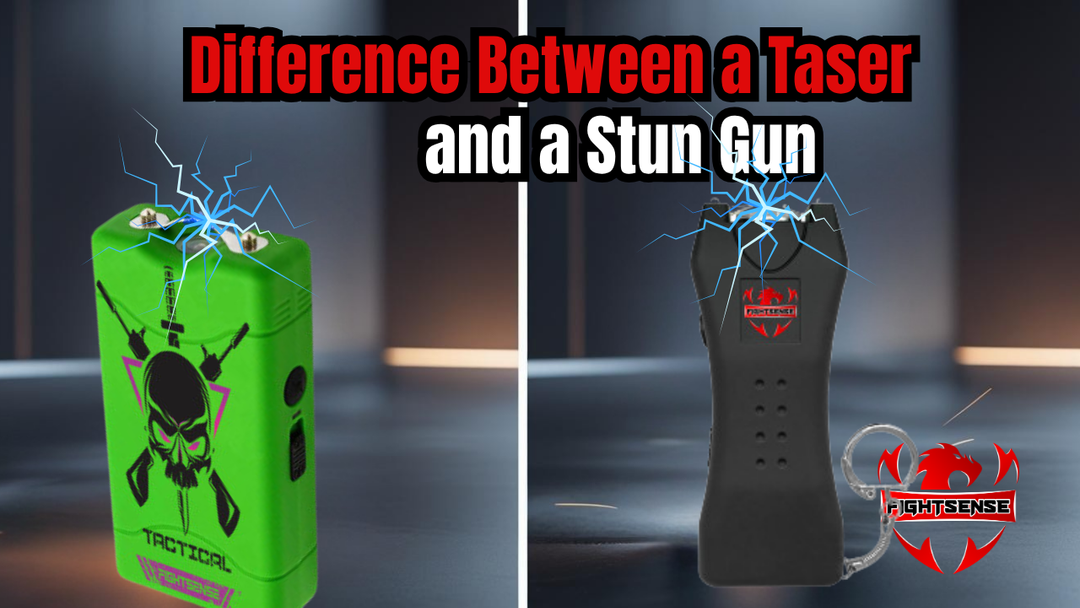
Difference Between a Taser and a Stun Gun Explained
In an era where personal safety is a top priority for individuals and families alike, knowing the precise differences between self-defense tools is essential. When it comes to non-lethal electroshock protection, the taser and the stun gun are the two most common options.
While both devices utilize electrical current to deter attackers, their underlying technology, operational range, legal status, and practical applications vary significantly. Understanding these distinctions ensures you make an informed, responsible decision for your personal security.
Keynotes
- Tasers work from a distance, whereas stun guns need to be touched directly.
- Stun guns are compact, affordable, and work well, making them convenient to use for self-defence.
- Tasers are hard to use, cost a lot of money, and are hard to understand.
- Different countries and states have different laws, so always check beforehand.
- Fightsense stun guns are effective, look good, and are legal where they are authorised.
What is a Stun Gun? Definition & Mechanism
A stun gun is a compact, close-quarter self-defense device designed to deliver a high-voltage, low-amperage electrical shock via direct physical contact.
- How It Works: When the metal contact prongs are pressed firmly against an attacker's body, the electric circuit completes. The current targets sensory nerves and skeletal muscles, causing intense discomfort, disorientation, and rapid muscle contractions. This disrupts voluntary muscle control and disorients the assailant, creating a window of time for the user to escape.
- Design & Portability: Stun guns do not fire any projectiles. They are engineered for portability and concealment, frequently manufactured to resemble everyday items such as tactical flashlights, mobile phones, lipstick tubes, keychains, and batons.
What Is a Taser? Key Operational Features
A taser (often classified as a conducted energy weapon or CEW) is a projectile-based electroshock device designed to neutralize threats from a distance.
- How It Works: Tasers use compressed nitrogen gas to fire two small metal darts (probes) attached to insulated copper wires. These probes can travel up to $15$ feet or more depending on the civilian model. When both probes successfully embed in clothing or skin, high-voltage pulses travel down the wires to induce neuromuscular incapacitation (NMI). Unlike pain compliance, NMI completely overrides the central nervous system, causing involuntary, total-body muscle lockup.
- Key Limitations: Tasers require sufficient clearance space to deploy safely and effectively. Furthermore, they feature single-use cartridges that must be physically replaced after every deployment, and the units themselves are bulkier and mechanically more complex.
Direct Comparison: Stun Gun vs. Taser
|
Feature |
Stun Gun |
Taser |
|
Operating Range |
Direct, touch-contact only |
Ranged projection (up to $15+$ feet) |
|
Primary Mechanism |
Pain compliance via localized shock |
Neuromuscular incapacitation (NMI) via probes |
|
Size & Portability |
Highly compact, pocket/keychain friendly |
Larger, holster-dependent tactical units |
|
Reloading / Reuse |
Reusable indefinitely (rechargeable battery) |
Requires single-use cartridge replacement |
|
Cost & Maintenance |
Highly affordable, minimal upkeep |
Significant upfront cost, ongoing cartridge expenses |
|
Deployment Skill |
Simple point-and-press operation |
Requires aiming, line of sight, and clearance space |
This clearly highlights the difference between a taser and stun gun especially for those who prefer portability and simplicity.
Operational Range & Tactical Distance
- Stun Guns: Strictly limited to close-quarters combat. To utilize a stun gun effectively, you must be within arm's reach of the assailant. This creates a higher risk in dynamic physical altercations if an attacker closes the distance before you can react, but it eliminates the risk of missing a long-distance shot.
- Tasers: Provide a crucial safety buffer. By allowing users to neutralize threats from a distance, tasers grant extra reaction time and keep dangerous individuals away from your personal space. However, if a probe misses or fails to make proper contact, the device's distance advantage is immediately lost.
Biological Impact & Physiological Effects
- Stun Gun Impact: Relies primarily on pain compliance. Because the effectiveness of a stun gun depends heavily on contact duration, pressure applied, clothing thickness, and the specific muscle group targeted, full incapacitation is variable and depends on an attacker's pain threshold or adrenaline level.
- Taser Impact: Capable of achieving neuromuscular incapacitation (NMI). By bypassing pain tolerance entirely and locking up motor functions, tasers make voluntary movement nearly impossible. This offers a much higher statistical rate of complete immobilization, securing a reliable window for escape.
Legality: What’s Allowed and Where?
Regulations regarding electroshock weapons vary dramatically by country, state, and local municipality:
- United States: Civilian ownership of stun guns is legally permitted in the vast majority of states. However, specific jurisdictions—such as Hawaii, New York, Rhode Island, and Washington, D.C.—impose strict permitting processes, outright bans, or heavy restrictions on either stun guns, tasers, or both.
- International Jurisdictions: Many countries classify tasers as prohibited firearms or restricted tactical gear due to their projectile firing mechanism, while stun guns are often subject to distinct localized consumer electronics regulations.
- Golden Rule: Always verify local municipal and state legislation before acquiring, carrying, or transporting any self-defense tool.
Choosing the Right Tool: Fightsense Recommendation
If you want a gadget that works effectively, can be charged, and is convenient to carry, our stun guns are perfect.
This is what makes Fightsense stun guns different:
- Strong voltage discharge with a switch for safety
- It has a flashlight with an LED and an emergency bell.
- You can charge it using a USB cable, which is excellent for the environment and useful.
- You may get it in both baton and keychain versions.
- Made for everyday people, runners, women, and businesspeople
The true difference between a taser and a stun gun is that our devices are easier to procure, cheaper, and more reliable for regular use.
Range & Distance: Key Difference Between a Taser and a Stun Gun
- Stun guns require close-contact. To use a stun gun effectively, the user must be very near or touching the intended target.
- Tasers allow longer range. Their projectiles can travel some distance (often up to ~10-15 feet under civilian-legal devices, though limits vary). That increased reach gives more time and space to respond before close engagement.
Effect & Impact
- A stun gun’s effect is largely dependent on contact, duration, and the thickness of clothing. Pain and compliance are the main intended results; full incapacitation is less consistent.
- A taser’s probes when properly connected may cause neuromuscular incapacitation, meaning muscles temporarily stop cooperating, making movement very difficult. This lets the user get distance or disarm the danger more reliably in many situations.
Safety & Risks
- Both devices can cause injury if misused or used against vulnerable individuals (e.g. those with certain medical conditions).
- With stun guns, risk comes from electric shock, burns, or being close enough for the attacker to counter-attack.
- With tasers, there’s also risk from probe penetration, fall injuries, or cardiac effects in rare cases if probes hit near vital areas.
- Proper training, responsible ownership, and adherence to law are key for both stun gun and taser safety. FightSense emphasizes safe use and legal compliance at all times.
Legal Considerations
- Laws governing stun gun vs. taser vary widely by state, country, or region. Some jurisdictions treat tasers as more regulated due to their projectile/distance capability.
- Carrying either device may require permit, license, or have restrictions on size, power, or intended use. Always verify local regulations before acquiring either device.
- Misuse regardless of device type (stun gun or taser) can lead to criminal liability, including assault charges.
Which One is Right for You?
When considering the difference between a taser and a stun gun and stun gun meaning, think about:
|
Factor |
Stun Gun |
Taser |
|
Need for distance |
Requires close-contact |
Allows some distance |
|
Ease of use |
Simpler mechanism, fewer parts |
More complex; needs probes/cartridge/maintenance |
|
Safety |
Less risk of probe injury, but higher risk in close combat |
Higher complexity, but can reduce risk if distance maintained |
|
Legal restrictions |
Often more lenient, but still regulated |
Often subject to stricter laws |
|
Cost & maintenance |
Usually lower cost, simpler upkeep |
Usually higher cost, replacement components needed |
Scenarios to Use a Stun Gun or Taser
- Late-night shopping: Close-range threats? Use a stun gun.
- Jogging or commuting: The Fightsense stun gun is tiny and convenient to take with you whether you go for a run or travel..
- Car breakdown: If your automobile breaks down, stay safe while you wait for help
- College campuses: It's normally okay to have stun guns when you're in college, and they are even advised.
- Tactical situations: Tasers might be beneficial for cops.
Every scenario further clarifies the taser stun gun difference, one is used for close control while the other is used for control from a distance.
Conclusion
Understanding the difference between a taser and a stun gun empowers you to make smarter, safer choices for personal protection. Tasers offer long-range defense but often come with legal limits and higher costs.
Stun guns, like those from FightSense, provide an effective, compact, and legally accessible option for everyday use. Whether you’re walking home at night or working in a high-risk environment, investing in the right self-defense device ensures peace of mind and safety wherever you go.
Frequently Asked Questions (FAQs)
Q1: What is the main difference between tasers and stun guns?
A taser fires electrical darts over a distance (up to 15 feet), whereas a stun gun requires direct physical contact with the target.
Q2: Which option is better for everyday personal use?
For most everyday civilians, a stun gun is more practical, cost-effective, compact, and easy to maintain than a taser.
Q3: Are stun guns and tasers legal to own everywhere?
No. Legality depends entirely on your local state and regional laws. Stun guns are widely permitted, but tasers face stricter regulations in several areas.
Q4: Do these devices cause permanent physical harm?
No. Both are designed for temporary non-lethal defense to neutralize threats safely without causing permanent physical injury.
Q5: What should I consider before buying a self-defense weapon?
Evaluate your daily routine, local legal restrictions, ease of carry, budget, and your comfort level with deploying a close-contact versus ranged device.
Disclaimer: This blog is for informational and educational purposes only. Regulations regarding self-defense weapons vary significantly by region. Always check your local laws before acquiring any protective device.