
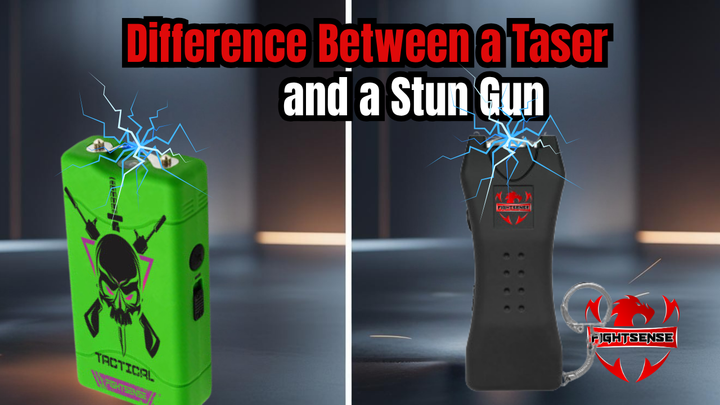
Difference Between a Taser and a Stun Gun Explained
4th Jul 2025
In a world where personal safety matters more than ever, knowing the difference between a taser and a stun gun is essential. While both are designed for protection, their technology, usage, and legal status differ in important ways.
Understanding these differences helps you make an informed, responsible decision especially if you’re looking to stay safe with trusted tools like those from FightSense.
Keynotes
- Tasers work from a distance, whereas stun guns need to be touched directly.
- Stun guns are compact, affordable, and work well, making them convenient to use for self-defence.
- Tasers are hard to use, cost a lot of money, and are hard to understand.
- Different countries and states have different laws, so always check beforehand.
- Fightsense stun guns are effective, look good, and are legal where they are authorised.
What Is a Stun Gun? How Does It Work?
When you touch a stun pistol, it sends an electric shock that can help you defend yourself in close quarters. The electric current strikes the attacker's muscles and nerves, which stops them from moving for a brief time but doesn't injure them for good.
The Fightsense stun guns are portable, safe, and easy to hold. These are perfect for fast, hands-on defence. Understanding this helps clarify the difference between a taser and a stun gun, which operates from a distance.
What Is a Taser? Key Operational Features
Tasers are weapons that shoot electric shock are connected by cables. The user can stop an attacker from as far away as 15 feet. The current flows through the wires, which functions like a stun gun to screw up the muscles.
Now here’s where the difference between a taser and a stun gun stands out: tasers require space to operate effectively, and their cartridges are often single-use.
Fightsense emphasises on tools that don't shoot things to make daily protection more reliable and useful for more than one thing.
Difference Between Taser and Stun Gun in Design & Range
|
Feature |
Stun Gun |
Taser |
|
Range |
Touch-contact only |
Fires darts up to 15 feet |
|
Size |
Compact, keychain sizes |
Larger, bulkier units |
|
Usage |
Requires physical contact |
Works from a distance |
|
Reloading |
No reload needed |
Cartridges are single-use |
|
Price |
More affordable |
Often significantly pricier |
This clearly highlights the difference between a taser and stun gun especially for those who prefer portability and simplicity.
Legal Differences: What’s Allowed and Where?
When considering the difference between a taser and a stun gun, legality plays a huge role:
- United States: Most states allow citizens to own stun guns. You might require a permit to use a Taser in some regions.
- Restricted Areas: Hawaii, New York, Rhode Island, and Washington, D.C. might not let either one happen.
- International: In many places around the world, tasers and zap guns are against the law.
- Fightsense’s Advice: Before you buy, make sure you know the rules in your area.
If you know the difference between a taser and a stun gun, you can make a sensible and safe option.
Choosing the Right Tool: Fightsense Recommendation
If you want a gadget that works effectively, can be charged, and is convenient to carry, our stun guns are perfect.
This is what makes Fightsense stun guns different:
- Strong voltage discharge with a switch for safety
- It has a flashlight with an LED and an emergency bell.
- You can charge it using a USB cable, which is excellent for the environment and useful.
- You may get it in both baton and keychain versions.
- Made for everyday people, runners, women, and businesspeople
The true difference between a taser and a stun gun is that our devices are easier to procure, cheaper, and more reliable for regular use.
Range & Distance: Key Difference Between a Taser and a Stun Gun
- Stun guns require close-contact. To use a stun gun effectively, the user must be very near or touching the intended target.
- Tasers allow longer range. Their projectiles can travel some distance (often up to ~10-15 feet under civilian-legal devices, though limits vary). That increased reach gives more time and space to respond before close engagement.
Effect & Impact
- A stun gun’s effect is largely dependent on contact, duration, and the thickness of clothing. Pain and compliance are the main intended results; full incapacitation is less consistent.
- A taser’s probes when properly connected may cause neuromuscular incapacitation, meaning muscles temporarily stop cooperating, making movement very difficult. This lets the user get distance or disarm the danger more reliably in many situations.
Safety & Risks
- Both devices can cause injury if misused or used against vulnerable individuals (e.g. those with certain medical conditions).
- With stun guns, risk comes from electric shock, burns, or being close enough for the attacker to counter-attack.
- With tasers, there’s also risk from probe penetration, fall injuries, or cardiac effects in rare cases if probes hit near vital areas.
- Proper training, responsible ownership, and adherence to law are key for both stun gun and taser safety. FightSense emphasizes safe use and legal compliance at all times.
Legal Considerations
- Laws governing stun guns vs tasers vary widely by state, country, or region. Some jurisdictions treat tasers as more regulated due to their projectile/distance capability.
- Carrying either device may require permit, license, or have restrictions on size, power, or intended use. Always verify local regulations before acquiring either device.
- Misuse regardless of device type (stun gun or taser) can lead to criminal liability, including assault charges.
Which One is Right for You?
When considering the difference between a taser and a stun gun, think about:
| Factor | Stun Gun | Taser |
|---|---|---|
| Need for distance | Requires close-contact | Allows some distance |
| Ease of use | Simpler mechanism, fewer parts | More complex; needs probes/cartridge/maintenance |
| Safety | Less risk of probe injury, but higher risk in close combat | Higher complexity, but can reduce risk if distance maintained |
| Legal restrictions | Often more lenient, but still regulated | Often subject to stricter laws |
| Cost & maintenance | Usually lower cost, simpler upkeep | Usually higher cost, replacement components needed |
Scenarios to Use a Stun Gun or Taser
- Late-night shopping: Close-range threats? Use a stun gun.
- Jogging or commuting: The Fightsense stun gun is tiny and convenient to take with you whether you go for a run or travel..
- Car breakdown: If your automobile breaks down, stay safe while you wait for help
- College campuses: It's normally okay to have stun guns when you're in college, and they are even advised.
- Tactical situations: Tasers might be beneficial for cops.
Every scenario further clarifies the difference between a taser and a stun gun, one is used for close control while the other is used for control from a distance.
Conclusion
Understanding the difference between a taser and a stun gun empowers you to make smarter, safer choices for personal protection. Tasers offer long-range defense but often come with legal limits and higher costs.
Stun guns, like those from FightSense, provide an effective, compact, and legally accessible option for everyday use. Whether you’re walking home at night or working in a high-risk environment, investing in the right self-defense device ensures peace of mind and safety wherever you go.
Disclaimer
Please keep in mind that this blog is exclusively for teaching. Some places have various rules about tasers and stun guns. Before you buy, Fightsense says to check the regulations in your area, state, and country. Take care of all your electronics.
FAQs
Q1: What is the main difference between tasers and stun guns?
A taser fires electrical darts from a distance, while a stun gun delivers a shock through direct contact.
Q2: Which is better for personal use?
For most civilians, a stun gun is more practical, affordable, and easier to carry than a taser.
Q3: Are both legal to own?
Legality varies by state. Stun guns are legal in most areas, but tasers may have restrictions.
Q4: Do both devices cause permanent harm?
No. Both are designed for temporary incapacitation and non-lethal defense.
Q5: Why choose FightSense for self-defense tools?
FightSense offers high-performance, rechargeable, and safety-tested stun guns trusted by users nationwide.