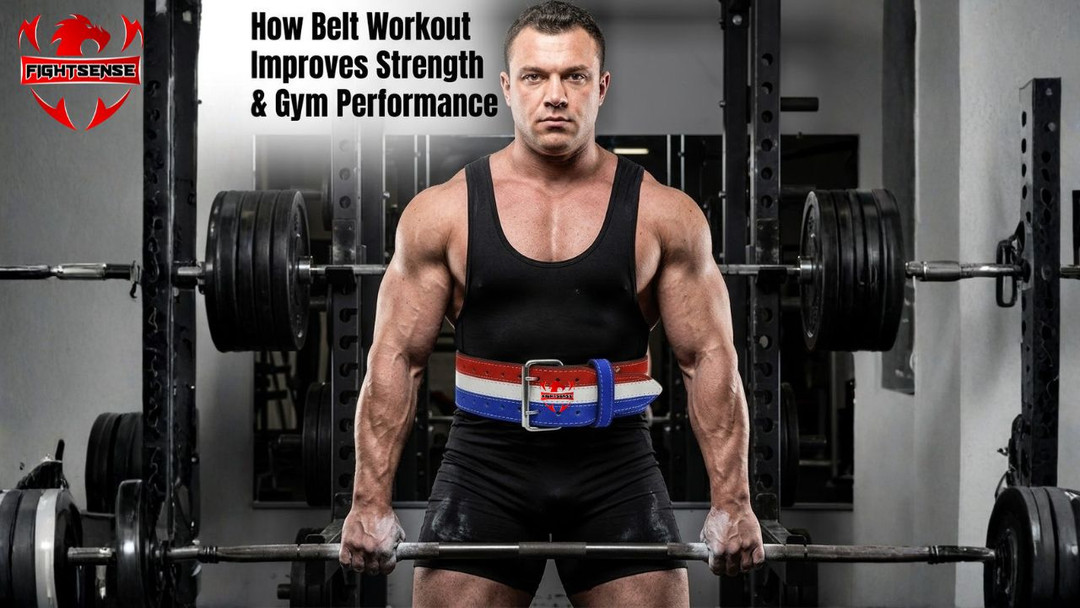
How Belt Workout Improves Strength & Gym Performance
Belt workout is commonly seen in the gym during heavy squats and deadlifts, where lifters wear a belt before lifting. It may look like a support shortcut, but it’s actually about improving control, stability, and smart strength training—not dependence.
A belt doesn’t lift the weight or fix form; it helps your body create more core pressure so you can lift heavier safely and efficiently.
In this guide, we’ll explore how belt workouts work, when to use them, mistakes to avoid, and how to include them in your training. We’ll also mention supportive gym gear like weightlifting belts and lever belts from Fightsense for serious lifters.
Key Highlights:
- A belt workout is a performance tool, not a shortcut—it enhances control, not strength itself.
- Proper bracing against the belt is what actually creates stability and power transfer.
- Use the belt strategically for heavy compound lifts, not every exercise.
- Balanced training (with and without belt) builds stronger long-term core strength.
The real benefit comes from technique mastery, not just wearing the belt.
What Is a Belt Workout?
A belt workout simply refers to a workout in which you use a weightlifting belt during your strength training workouts, especially while completing compound lifts with big weights.
But here’s the thing: It’s not a “belt workout routine.” This is an improvement in training methods.
Same exercises you still do:
- Squats
- Dead Lift
- Presses overhead
- Bent-over row
- Variations of the Olympic lift
The belt is just support to help your core brace so your spine is more stable under pressure.
Imagine yourself in a fast car with a seatbelt. The car still handles the same way but your body is more secure within it.
How Do Weight Lifting Belts Work?
Most folks get this portion wrong. They think the belt provides immediate support to the back, like a brace or strap. “That’s not true.
How does a weightlifting belt function ? Well , it helps you build something called intra-abdominal pressure .
Let’s make things simple:
So , as you breathe deep into your stomach and brace your core against the belt , your abdominals push outward against the belt . The belt displaces. This forms a tight, pressurised “cylinder” around your midsection.
That pressure:
- Keeps your spine stable
- Reduces unnecessary bending.
- Helps transmit force more efficiently
- more powerful mechanics for large lifting
So instead of your lower back doing all the stabilising job, your whole core system works together more efficiently.”
How Does a Weightlifting Belt Make You Stronger?
Increased stability for heavy loads
The heavier the weights, the more difficult it is to stay in excellent form. Belt training helps you keep your core tight and spine solid during squats, deadlifts and overhead presses for cleaner, more controlled reps.
Strength & Confidence Boost
A belt won't give you additional strength, but it helps you to use the strength you have better. With better support you feel more confident lifting heavier weights and pushing beyond plateaus.
Additional Core Activation
A belt doesn’t cut down on core work, it enhances your engagement with it. Pulling your stomach in against the belt helps you maintain a tight, regulated core during hard compound movements.
Less Strain on the Low Back
A belt helps to spread the pressure across your core and takes the additional pressure off your lower back during max-effort lifts while still maintaining a strong effective effort.
When Should You Use a Belt in Training?
This is where many lifters go wrong—they either overuse the belt or avoid it completely.
The truth is somewhere in the middle.
Use a Belt for Heavy Compound Lifts
You should consider using a belt when:
- You’re lifting around 80% or more of your max
- You’re doing low-rep strength work (1–6 reps)
- You’re attempting personal records
- You’re training near failure with heavy loads
Don’t Use a Belt for Everything
A common mistake is wearing it for:
- Light warm-up sets
- Isolation exercises
- Machine workouts
- High-rep endurance training
This can reduce your natural core development if overused.
Smart Rule of Thumb
Use the belt when:
“The weight demands maximum stability.”
Skip it when:
“The goal is muscle endurance or control development.”
Best strength training gym gear:
Once you start taking lifting seriously, the quality of your gear starts to matter a bit more.
Fightsense makes gym clothes for strength training, such as weightlifting belts and lever belts that help you stay stable when you're doing large compound lifts.
Durability is not the only reason supportive gear like this is necessary, it is consistency. If your belt fits and functions reliably, then you can stop worrying about it during your training. "You just concentrate on the elevator.
This is especially crucial when you are working on:
- Progressive over load
- Strength cycles
- Personal files
- Reps under heavy control
Good gear doesn’t replace effort, it supports it.
How to Wear a Weightlifting Belt Correctly?
Wearing a belt incorrectly is almost as useless as not wearing one.
Let’s fix that.
Step 1: Positioning
Place the belt around your midsection:
- Above hip bones
- Below ribs
- Centered around your core
Step 2: Tightness
It should be:
- Tight enough to brace against
- Loose enough to take a deep breath
If you can’t expand your stomach slightly when bracing, it’s too tight.
Step 3: Bracing Technique
Before every rep:
- Take a deep breath into your stomach
- Expand your core outward
- Push against the belt
- Lock in tension
- Lift
This is where the real benefit happens
How to Structure a Belt Workout in Your Training Plan
Here’s a simple, practical approach:
Warm-Up (No Belt)
- Mobility work
- Light sets
- Activation exercises
Working Sets (Optional Belt Use)
- Heavy squats
- Heavy deadlifts
- Overhead presses
Accessory Work (No Belt)
- Lunges
- Rows
- Core training
- Machines
This balance keeps your strength progressing while still developing natural stability.
Common Mistakes in Belt Workouts:
Let’s fix some bad habits early.
Relying on the Belt Too Much: A belt is support—not a replacement for core strength.
Wearing It Too Tight: If you can’t breathe and brace properly, your performance drops.
Using It for Every Exercise: Not every movement needs spinal support.
Ignoring Bracing Technique: The belt only works if you actively push against it.
Thinking It Prevents Injury Automatically: It reduces risk, but form still matters most.
Conclusion:
A belt workout is not a shortcut. It is a refinement in strength training. What a weightlifting belt does ( when used properly ) is allows you to lift more weight with better control , improves stability under load , and strengthens core bracing during heavy lifts . Balance is crucial!
Don’t use it for every workout, but don’t ignore it when it’s needed. Think of it as a supportive tool that helps your training, not the basis of it. One easy yet wise enhancement for the long-term growth in the gym is the right usage of a belt, when and how.
FAQs:
1. Should I use a belt for every heavy set?
No, use it only for near-max or top working sets. Overuse can reduce natural bracing strength development.
2. Does a lifting belt actually make you stronger?
It doesn’t increase muscle strength directly, but it helps you express more strength safely by improving stability and pressure control.
3. Can beginners start using a belt?
Yes, but only after learning proper form and core bracing. Beginners should not rely on it too early.
4. What’s the ideal tightness for a belt?
Tight enough to brace against, but loose enough to allow deep abdominal breathing and expansion.
5. Is a lever belt better than a prong belt?
Lever belts offer quicker setup and consistent tightness, while prong belts give more adjustability. Both work well depending on preference.