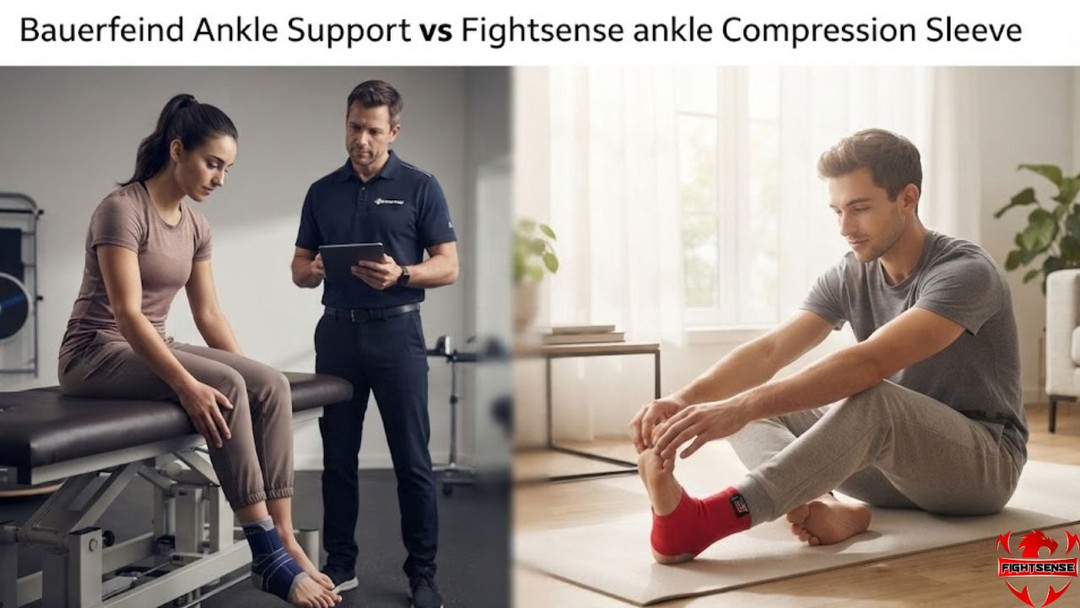
Bauerfeind Ankle Support vs Fightsense ankle Compression Sleeve
When you are weighing the clinical-grade security of a Bauerfeind Ankle Support against the versatile feel of a Fightsense Compression Sleeve, ankle recovery gets complicated. Whether you rolled your foot during a heavy deadlift or stepped off a curb wrong, choosing between heavy medical rigidity and breathable everyday comfort is tough. Let's break down everything you need to know.
What Actually Happens Inside Your Ankle When You Roll It?
When you roll your ankle compression sleeve, the ligaments holding your bones together stretch past their limits or tear entirely. Your body immediately responds with inflammation, flooding the area with fluid that causes rapid swelling, stiffness, and sharp pain.
Combatting this trauma requires two essential things: compression to manage fluid buildup and support to prevent awkward joint shifts during healing. Because every injury is unique, choosing the right gear is critical to getting you back on your feet safely.
Why Do So Many Athletes Talk About the Anatomy of a Sprain?
Understanding your healing phase changes how you choose your gear. Ankle brace for sprains are generally broken down into three grades:
- Grade 1 (Mild): Slight stretching and microscopic tearing of the ligament fibers. There is minimal instability, but minor swelling and tenderness are present.
- Grade 2 (Moderate): A partial tear of the ligament. You will notice moderate swelling, bruising, and noticeable joint instability when putting weight on it.
- Grade 3 (Severe): A complete tear or rupture of the ligament. This involves severe swelling, extreme pain, and complete joint instability that requires professional medical intervention.
Matching your gear to your specific grade of injury is crucial. Wearing a heavy medical brace for a minor tweak is overkill, just like wearing a light sleeve for a severe tear is dangerous.
Is Bauerfeind Ankle Support Really Worth the High Price Tag?
If you have ever talked to an orthopedic surgeon, a physical therapist, or a professional athlete coming off major surgery, you have likely heard of Bauerfeind. They are often considered the gold standard in clinical-grade joint stabilization. But do they live up to the massive hype for the everyday gym-goer?
The Good: Clinical-Grade Stability and Medical Engineering
The Bauerfeind Ankle Support is built like a medical fortress. It features an anatomical, medical-grade knit embedded with targeted silicone inserts (similar to their renowned MalleoTrain design concepts). These pads apply intermittent, localized pressure right where you need it most, massaging soft tissue, boosting circulation, and rapidly driving down stubborn swelling. If you are dealing with severe ligament laxity or a Grade 2/3 sprain where your ankle feels like it might give out at any second, this level of structural rigidity provides unmatched psychological and physical peace of mind.
The Drawback: Stiffness, Heat Retention, and Bulk
However, that heavy-duty medical focus comes with some notable compromises. Because the material is thick and heavily structured to prevent lateral rolling, it doesn't breathe particularly well. If you wear it for hours during a long office shift or a grueling gym session, your best ankle support is going to trap heat and sweat. Furthermore, the lack of flexibility means it restricts extreme ranges of motion. While that is great for stopping a dangerous re-injury, it can feel bulky, stiff, and downright annoying if you are trying to stay active or squeeze into standard, snug athletic shoes.
Can the Fightsense Compression Sleeve Handle Real Recovery?
On the other end of the spectrum, we have the Fightsense Compression Sleeve. Designed with a modern, performance-first mindset, this sleeve takes a very different path toward healing—focusing on agility and consistent wear.
The Good: All-Day Comfort, Breathability, and Dynamic Mobility
Instead of locking your joint into a rigid medical cast, Fightsense focuses on graduated, dynamic compression. It hugs your foot and ankle tightly, targeting micro-circulation to flush out metabolic waste and reduce swelling, all while letting you move naturally. Crafted from a lightweight, highly breathable fabric matrix, you can slip it on in the morning, wear it through an 8-hour workday, hit the gym, and wear it home without your skin feeling suffocated or irritated.
The Drawback: Not Built for Severe Structural Trauma
To be completely fair and transparent, a soft sleeve cannot compete with a heavy-duty orthopedic ankle brace support if your ankle is structurally compromised. If you have completely torn a ligament and need a rigid physical barrier to stop lateral movement, Fightsense won't offer enough structural lockdown on its own. It is designed for mild-to-moderate strains, active recovery, and preventative support, rather than heavy post-surgical immobilization.
Head-to-Head Comparison: How Do They Stack Up Side by Side?
To make your decision easier, let's put them face-to-face across the metrics that actually matter during your recovery journey.
|
Feature |
Fightsense Compression Sleeve |
Bauerfeind Ankle Support |
|
Primary Focus |
Active recovery, mobility, and daily comfort |
Medical-grade rehabilitation and severe stabilization |
|
Material & Breathability |
Lightweight, highly breathable, moisture-wicking |
Dense, heavier knit; retains more heat over time |
|
Range of Motion |
High flexibility; allows full athletic movement |
Restricted; built to limit dangerous lateral shifts |
|
Bulkiness |
Low profile; easily slips into regular sneakers |
Thicker build; may require looser footwear |
|
Price Point |
Budget-friendly and high-value |
Premium, medical-grade investment |
Which One Should You Actually Buy for Your Specific Injury?
Choosing the right support isn't about finding the "best" product on a generic marketing list—it's about finding the best product for your specific ankle, your pain level, and your daily routine.
Ask yourself these two critical questions:
- How severe is the pain and instability? If you can barely put weight on your foot and a doctor has diagnosed a significant tear or severe sprain, you need maximum structural lockdown.
- What does your daily lifestyle look like? If you are an active person who needs to keep moving, work on your feet, or transition straight from recovery into light training without feeling weighed down, comfort and breathability are king.
If you lean toward medical immobilization and serious protection, the Bauerfeind Ankle Support is hard to beat. But if your goal is maintaining mobility, managing mild swelling, and staying comfortable all day long without breaking the bank, the Fightsense sleeve clearly takes the crown for everyday usability.
Conclusion:
Recovering from an ankle injury doesn't mean you have to put your life on hold, but it does mean treating your joints with respect and intelligence. Both of these options serve a distinct purpose in the healing ecosystem.
If you are navigating a severe injury and require clinical-grade immobilization, the Bauerfeind Ankle Support delivers the heavy-duty protection you need. However, for most everyday sprains, active individuals, and those looking for breathable, all-day comfort that won't empty their wallets, a versatile compression sleeve is the smarter, more practical companion for your road to recovery.
FAQs:
Can a compression sleeve prevent a re-injury during heavy lifts?
Yes, continuous feedback from a tight sleeve enhances your joint awareness to help maintain better form under heavy loads.
Will a medical-grade brace weaken my ankle over time?
If worn unnecessarily for minor tweaks, a rigid brace can make surrounding stabilizing muscles lazy by doing all the work.
Do compression sleeves help with chronic morning stiffness?
Yes, wearing a lightweight sleeve shortly after waking up can help flush out overnight fluid accumulation and reduce stiffness.
Are tight sleeves safe to wear during hot outdoor workouts?
Breathable performance sleeves are designed to wick sweat and keep you cool, unlike thick medical knits that trap excessive heat.
How tight is too tight when choosing a recovery sleeve?
If your toes start tingling, turning cold, or changing color, the compression level is too high and restricts healthy blood flow.
Do these supports help with tendonitis as well as ankle sprains?
Yes, targeted compression provides soothing warmth and pressure that alleviates inflammation associated with Achilles tendonitis.
Disclaimer:
This article is for informational purposes only and does not constitute medical advice. Always consult with a qualified healthcare provider or physical therapist before starting any recovery regimen or choosing medical equipment for an injury.