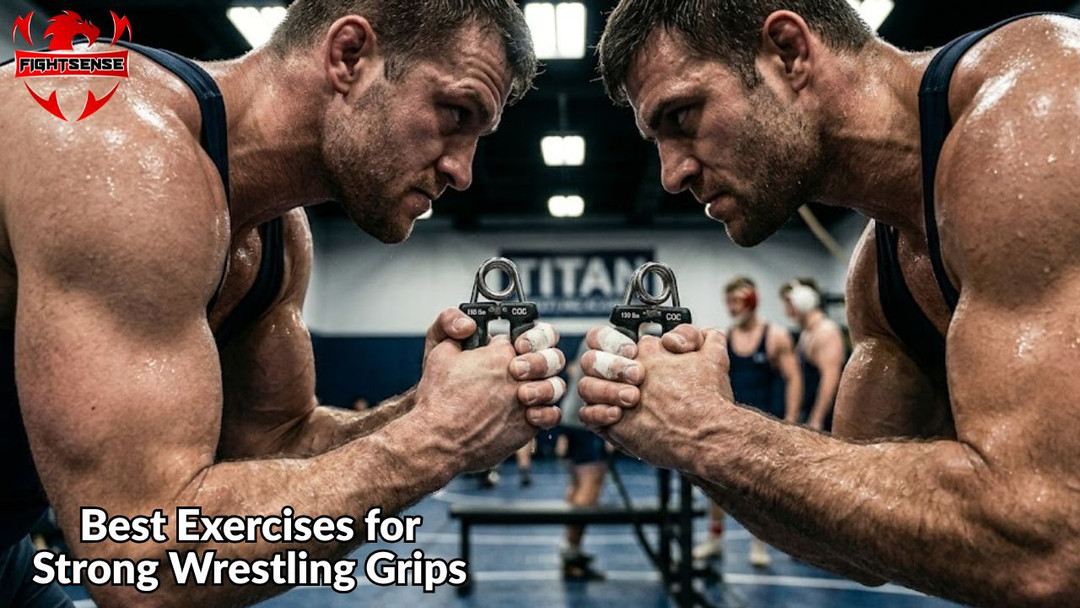
Best Exercises for Strong Wrestling Grips
Wrestling grips are essential whether you’re pinning an opponent or dominating in arm wrestling. Many athletes underestimate the value of strong, flexible grips, but success relies on more than just hand strength—it’s about full-body control, precision, and stability. Fightsense provides premium grip support gear for athletes who demand the best.
In this guide, you’ll learn how to develop the ultimate arm wrestling grip, improve performance in matches, and train like a pro using authentic, athlete-approved Fightsense equipment.
Keynotes:
- Strong wrestling grips improve control, balance, and match dominance.
- Grip strength depends on muscles, endurance, and nervous system coordination.
- Exercises like dead hangs, farmer’s walks, and towel pull-ups are highly effective.
- Consistent training with proper recovery prevents fatigue and injury.
- Grip development must be combined with technique and live wrestling practice.
What Makes Grip Strength So Important in Wrestling?
Grip strength is always being challenged in wrestling in unanticipated and high pressure circumstances. Your hands and forearms are constantly busy, whether you’re closing down, defending a takedown or controlling on the ground.
When grip strength is poor:
- Opponents can easily break control
- Holds become unstable with fatigue
- Technical execution in subsequent rounds is lacking
With a strong grip:
- The control is kept even under pressure
- Defensive escapes are harder for opponents
- Matches Efficiency becomes better
This is why grip development is not optional, it’s a performance requirement.
The Science of Grip Strength: A Performance Perspective:
Grip strength is not a single muscular motion. It is the synchronised activation of:
- Flexors of fingers
- Forearm musculature
- Wrist rests
- Neural control systems
Sports science refers to grip as a neuromuscular endurance attribute, a trait that depends on both muscle strength and the efficiency of the nervous system. That is why trained athletes can hold longer grip even though muscle size is similar with the beginners.
Elite-Level Exercises for Wrestling Grips Development:
Here are systematic, performance-based exercises for combat sports conditioning programs.
Training with Progressive Hand Gripper
Hand grippers are also great for building crushing strength.
Training protocol: -
- 3-4 sets/hand
- 8–15 reps under control
- 5-10 second maximum holds
- Resistance increase every 1-2 weeks gradual
This increases finger and palm strength for precise control in grappling exchanges.
Dead Hangs, Static and Weighted
Dead hangs can enhance grip endurance under bodyweight pressure.
Progression model:
- Bodyweight Hang (Basic Level)
- Weighted hang (advanced)
- Hang towel (elite diff.)
In actual wrestling grips correlates to better endurance in protracted clinch clashes.
Pull-Ups on Towel
It’s a very sport-specific movement.
Why it works:
The unsteady surface demands more forearm involvement and develops better grip adaptability.
Execution 1.
- Sets: 3-5
- 5-10 reps controlled
- Just whole range of motion
This directly improves functional grip transfer to wrestling positions.
Farmer’s Walk (Strength of Loaded Carry)
A fundamental movement in strength and conditioning training.
The protocol:
- Heavy kettlebells/dumbells
- 3–5 sets 20–40 meter walks
This increases grip endurance under pressure and trains posture stability which is crucial in wrestling grips stance control.
Plate Pinch Holds (Finger Strengthening)
This works on pinch strength, something athletes frequently don’t exercise enough.
Procedure:
- Hold two plates just with fingertips
- Pause for a while (20-60 secs)
- Gradually increase load
Improves precise control in close grappling encounters.
Benefits in Real Wrestling Situations:
Better grip strength gives demonstrable competitive benefits that immediately affect performance in a match, control and endurance on the mat. Strong grip training increases not only hand power, but overall wrestling efficiency in offensive and defensive situations.
Dominant clinch control
Higher grip strength athletes can hold control for a longer period of resistance. This provides for superior hand fighting, greater placement and the ability to command where the opponent moves, especially in clinch situations. It also decreases the risks of losing control in scrambles.
Better Takedown Performance
Strong grip improves success rate in entrance and finishing phases of takedowns. It helps regulate upper body alignment, sustain pressure and secure wrists in throws or leg attacks. This leads to a more successful and cleaner takedown when under pressure.
More resistant to fatigue.
An important determinant in postponing performance deterioration in the later rounds is grip endurance. Better grip conditioning means wrestlers can continue to apply force as their overall energy levels decrease. This helps keep consistency throughout the battle, especially in long and difficult fights.
Prevent Injury
The forearms and wrists develop stronger muscles, tendons and connective tissues that decrease strain and overuse injuries. The proper grip training aids joint stability and prevents athletes from suffering typical injuries including wrist sprains, forearm fatigue and ligament tension.
Defensive Stability
Good grip strength helps break opponent control and repel escapes more effectively. It lets athletes get out of bad positions, defend against submissions or holds, and remain balanced through defensive transitions.
Recovery and Adaptation Principles:
Grip muscles recover differently than larger muscle groups.
Key recovery methods:
- Forearm stretching after training
- Adequate rest between sessions
- Hydration and electrolyte balance
- Sleep optimization for neuromuscular recovery
Recovery is essential for long-term strength development.
Nutrition Support for Grip Performance
Grip strength development is supported by:
- Protein (muscle repair and adaptation)
- Magnesium (neuromuscular function)
- Omega-3 fats (joint health)
- Hydration (muscle efficiency)
Without proper nutrition, training adaptation is significantly reduced.
Modern Perspectives on Grip Strength in Wrestling:
Grip strength is one of the most well-known factors in modern wrestling that directly effects control, balance and performance in matches. Now athletes and coaches are working on strengthening grip endurance and technical skills to be more effective in actual competition. The goal is to create strength that can be deployed under pressure, not just in isolated training sessions.
Fightsense are frequently associated with conversations about athlete growth and boosting performance in the combat sports arena. The mention of such things underscores the growing consciousness towards systematic and sophisticated ways of training in wrestling.
Common Training Errors:
Athletes often fail due to:
- Overtraining without recovery cycles
- Ignoring progressive overload
- Lack of sport-specific application
- Training strength without endurance balance
- Poor technical form during exercises
Correcting these mistakes leads to faster adaptation and better results.
FAQS:
1. What type of grip strength is most important in wrestling?
All three matter—crushing, supporting, and pinch grip—but supporting grip is most important because it helps maintain control during prolonged clinch and scrambles.
2. Why does grip fail even if someone is strong?
Because strength alone is not enough. Grip often fails due to low endurance, poor conditioning under fatigue, or lack of sport-specific training.
3. How can wrestlers train grip for real match situations?
By combining static holds (like dead hangs) with dynamic drills such as carries, rope work, and live grappling under fatigue
4. Can overtraining grip reduce performance?
Yes, excessive grip training can cause forearm fatigue, reduced recovery, and weaker performance in actual wrestling sessions.
5. What is the best way to progress grip training?
Gradual overload—by increasing resistance, hold time, or training complexity over time while maintaining proper recovery