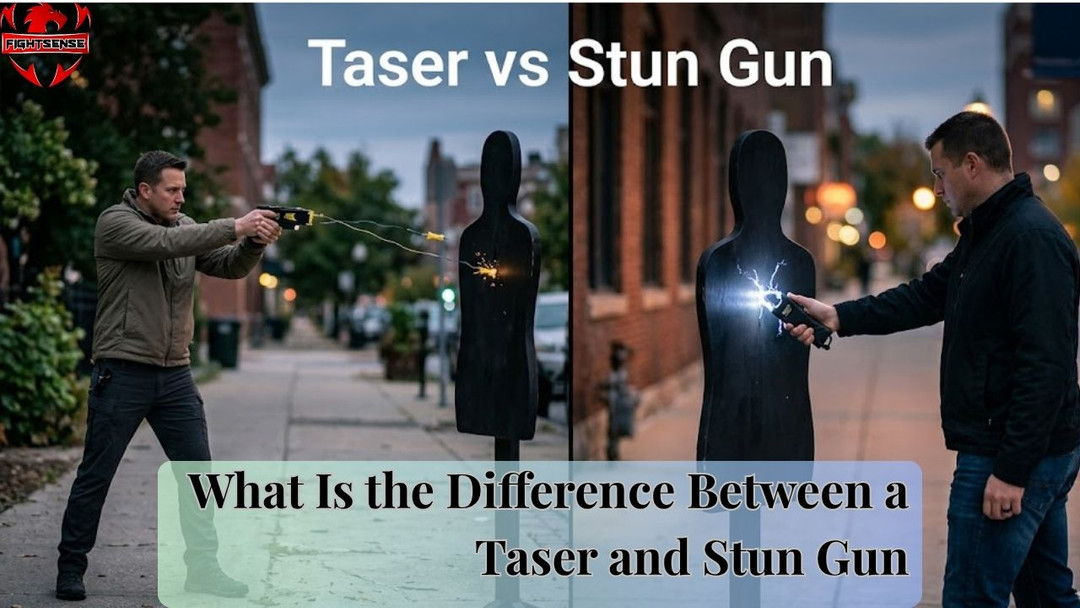
What Is the Difference Between a Taser and Stun Gun
A sudden feeling of insecurity can change how you think about personal safety. That’s why many people ask a simple but important question: what is the difference between a taser and stun gun?
At first glance, both devices seem similar—they deliver electric shock and are used for self-defense. But in real-life situations, they work in completely different ways. One protects you from a distance, while the other is designed for close encounters.
Understanding this difference is not just about features—it’s about choosing the right tool that could impact your safety when seconds matter.
In this guide, we’ll break everything down in a simple, real-world way so you can make a confident and informed decision.
Quick Highlights You Should Know
- Tasers work from a distance, stun guns require direct contact
- Tasers can temporarily stop muscle movement
- Stun guns rely on pain and disorientation
- Laws vary widely depending on location
- Each device suits different real-life situations
What is the difference between a taser and stun gun, explained?
A taser is a long-range self-defense device that fires probes to temporarily disable an attacker’s muscle control from a distance. A stun gun is a close-range device that requires direct contact and works by delivering an electric shock that causes pain and disorientation. Tasers focus on immobilization from afar, while stun guns rely on close-contact defense.
What Is a Taser?
A taser is a distance-based self-defense device designed to stop an attacker before they reach you.
Instead of direct contact, it uses small probes that are fired toward a target.
How it works in real life:
When triggered:
- Two probes shoot out and attach to the target
- Thin wires connect the device to the attacker
- Electrical pulses disrupt muscle control
- The attacker temporarily loses coordination
This process is known as neuromuscular disruption, meaning the body’s movement system is interrupted for a short time.
In simple terms: a taser gives you space when danger is approaching.
What Is a Stun Gun?
A stun gun is a close-range self-defense tool that works only when it directly touches the attacker.
Unlike a taser, it doesn’t shoot anything. Instead, it delivers a strong electric shock through direct contact.
How it works:
- You press the activation button
- The device must touch the attacker
- High-voltage shock is delivered instantly
- The attacker feels pain and confusion
In simple terms: a stun gun works when the threat is already close to you.
Key Differences Between Taser and Stun Gun
Let’s simplify everything into real, practical differences:
1. Range
- Taser: Works from several feet away
- Stun Gun: Requires direct contact
2. Effect on Body
- Taser: Temporarily disables muscle control
- Stun Gun: Causes pain and disorientation
3. Ease of Use
- Taser: Requires aiming and timing
- Stun Gun: Simple press-and-use operation
4. Portability
- Taser: Larger and more noticeable
- Stun Gun: Compact and easy to carry
5. Cost
- Taser: More expensive
- Stun Gun: Budget-friendly option
Real-Life Scenarios: Which One Works Better?
Walking Alone at Night
If someone is approaching from a distance, a taser gives you the advantage of space and reaction time.
Crowded Public Areas
In tight spaces, aiming may not be possible, making a stun gun more practical.
Sudden Close Attack
When an attacker is already near you, a stun gun reacts instantly without needing aim.
Real-life safety is not about power—it’s about timing and situation.
Laws and Legal Differences (Very Important)
Self-defense tools are not regulated the same everywhere, and laws can change significantly depending on your location.
United States Overview
- No federal ban on tasers or stun guns
- Laws differ by state
Restricted or Controlled States:
- Rhode Island (restricted civilian use)
- Illinois (FOID requirement)
- Massachusetts (strict regulations)
- Hawaii (purchase restrictions)
Permit Required in Some States:
- Connecticut
- Delaware
- Michigan (tasers require license)
- Minnesota (background checks in some cases)
Mostly Legal States:
- Texas
- Florida
- Arizona
- Georgia
- Nevada
International Note (Important for Pakistan & others)
In many countries including Pakistan:
- Laws may be unclear or strictly enforced
- Carrying such devices can create legal risks
- Always check local regulations before possession
Legal awareness is just as important as device choice.
Safety and Responsible Use
Both tasers and stun guns are non-lethal tools, but they must be used responsibly.
Safety Rules:
- Use only for genuine self-defense
- Keep away from children
- Learn basic operation before carrying
- Store safely when not in use
Common Mistakes:
- Buying without checking legality
- Ignoring training or practice
- Overestimating effectiveness
- Using in non-emergency situations
Which One Should You Choose?
Choosing between them depends on your lifestyle, not just the device.
Choose a Taser if:
- You want distance protection
- You feel safer with early response capability
- You are comfortable aiming under pressure
Choose a Stun Gun if:
- You want something simple and compact
- You prefer close-range protection
- You need a budget-friendly option
The best device is the one you can actually use confidently in real pressure situations.
Why Compact Self-Defense Tools Are Growing in Popularity
Modern users prefer tools that are:
- Easy to carry daily
- Quick to activate
- Simple to understand
- Practical in emergencies
That’s why more people are choosing Fightsense for reliable and compact self-defense solutions. Fightsense focuses on practical designs that are easy to use in real situations, helping users stay prepared without unnecessary complexity.
The Bigger Truth Behind This Decision
When people search what is the difference between a taser and stun gun, they are really asking something deeper:
“Which tool will actually protect me when it matters most?”
The answer depends on:
- Your environment
- Your comfort under stress
- Your ability to respond quickly
Modern Self-Defense Approach (Brand Perspective)
Today’s self-defense is not about complexity—it’s about practicality.
Modern users want tools that are:
- Easy to carry
- Fast to use
- Reliable under pressure
That’s why many people prefer simple, compact solutions that fit naturally into daily life without complication.
FAQs
1. Can a taser be used more than once?
Yes, but each use typically requires a new cartridge depending on the model.
2. Do stun guns stop working over time?
Only if the battery is not maintained properly. Regular charging keeps them effective.
3. Which is easier to use under stress?
Stun guns are generally easier because they don’t require aiming.
4. Can I carry these in my bag?
Yes, but only if local laws allow concealed carry.
5. Are tasers more powerful than stun guns?
They work differently—tasers immobilize, stun guns cause pain.
6. Do I need training to use them?
Not required, but basic practice is strongly recommended.
Quick Recap
- Tasers = distance + temporary immobilization
- Stun guns = close contact + pain-based defense
- Laws vary by region
- Choice depends on lifestyle, not power
Conclusion
Understanding what is the difference between a taser and stun gun is not just about technology—it’s about real-life safety decisions.
A taser gives you space when danger is far. A stun gun gives you immediate response when danger is close.
There is no “perfect” tool—only the one that fits your situation, comfort level, and legal boundaries.