Pit Shark Belt Squat: Guide & Best Alternatives
The Pit Shark belt squat has taken over commercial gyms and serious powerlifting facilities nationwide. If you want to build massive quads, glutes, and hamstrings without wrecking your spine, this specialized lower-body machine is a game-changer. Standard barbell back squats place hundreds of pounds directly onto your spinal column. In contrast, a belt squat loads your hips directly, offering pure lower-body isolation with zero axial loading.
In this ultimate guide, we break down how the Pit Shark works, its benefits, proper form, common mistakes, and how to replicate the movement using affordable alternatives like the FightSense Heavy-Duty Dip Belt.
What is a Pit Shark Belt Squat?
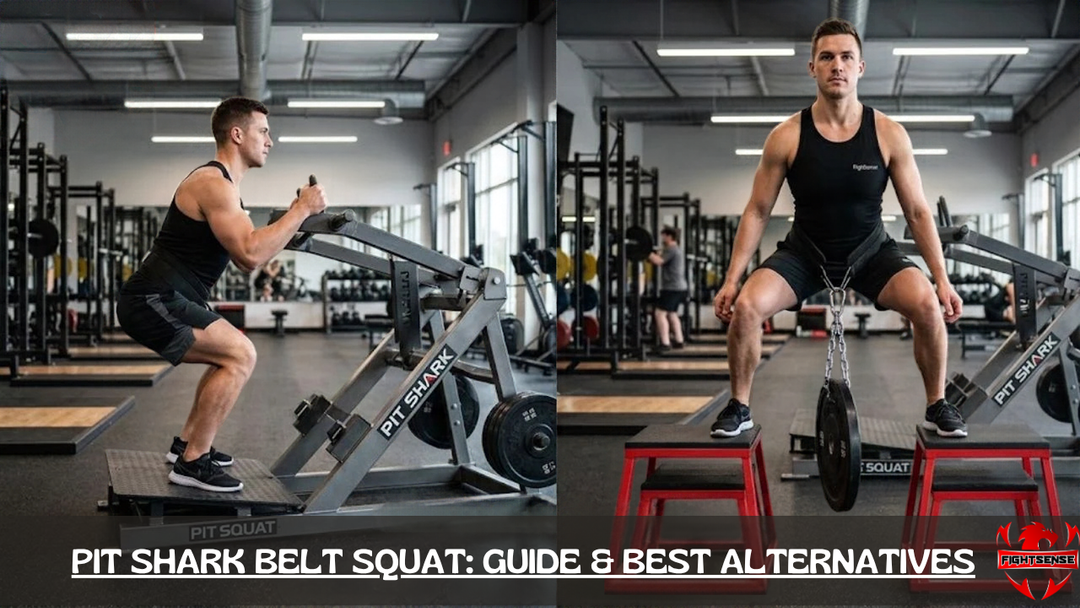
The Pit Shark is a specialized plate-loaded strength training machine designed specifically for belt squats, weighted dips, calf raises, and bent-over rows. Manufactured by Blackiron Strength, the machine features a platform with a center cutout and a lever arm underneath that holds weight plates.
Key Takeaway: Unlike traditional back squats where a heavy barbell sits across your upper traps, the Pit Shark connects weight to a wide, padded belt worn around your waist. This completely removes compressive stress from your spine.
How the Pit Shark Works
The engineering behind the Pit Shark is simple yet highly effective:
- Platform & Drop-Through: You stand on two raised platform decks separated by a central channel.
- Leverage Arm: The weight plates attach to a heavy-duty steel lever mechanism underneath the platform.
- Belt Attachment: You wear a wide, padded belt that clips into the lever arm using a chain and carabiner.
- Safety Lock Mechanism: A hand-released safety lever holds the weight in place until you reach the top of your movement.
When you squat down, the weight travels along a natural arc below the platform, allowing you to hit full depth without the weight hitting the floor.
Key Benefits of the Dip Belt for Squats
Zero Axial Loading on the Spine
Traditional back squats compress your vertebrae. For lifters with lower back pain, herniated discs, or spinal fatigue, heavy back squatting is often impossible. The Pit Shark completely bypasses the spine, transferring 100% of the resistance directly to your pelvic girdle and leg musculature.
Maximum Quad and Glute Isolation
Because your upper body does not need to stabilize a heavy barbell, your nervous system can direct all force output toward your quads, hamstrings, and glutes. This results in cleaner quad engagement and an exceptional pump.
Complete Safety Without a Spotter
Failing a barbell squat carries severe injury risks. With the Pit Shark, if your legs give out mid-rep, you simply pull the safety lockout handle back into place or drop into a deep stretch where the machine catches the load safely.
How to Perform the Weighted Squat Belt Squat with Perfect Form
Step 1: Secure the Belt
Wrap the belt around your lower waist and hips, ensuring the padding sits comfortably above your glutes. Secure the front carabiner to the middle link of the machine’s chain.
Step 2: Set Your Stance
Step onto the raised platform decks. Set your feet shoulder-width apart with your toes angled slightly outward (15–30 degrees).
Step 3: Disengage the Safety
Stand up tall to lift the weight stack slightly, grab the safety handle, and pull it back to disengage the lock mechanism.
Step 4: Squat to Full Depth
Hinge at your hips and bend your knees simultaneously. Lower your body under control until your thighs are parallel to the platform (or slightly below). Hold on to the machine's handrails lightly for balance if needed.
Step 5: Drive Upward and Lock Out
Push firmly through your full foot, driving your hips upward until you stand tall. Re-engage the safety mechanism once your set is complete.
The Best DIY Belt Squat Alternatives (No Machine Required)
Not every commercial gym or home gym setup has a dedicated $4,000 Pit Shark machine. Luckily, you can achieve identical biomechanical benefits using budget-friendly alternatives.
The DIY Dip Belt & Plyo Box Setup
This is the most popular and effective way to replicate a Pit Shark squat anywhere.
- Equipment Needed: Two sturdy plyo boxes (or weight benches) and a FightSense Heavy-Duty Dip Belt.
- How to Do It: Set two plyo boxes parallel to each other, leaving an 18-inch gap in the middle. Strap on your FightSense Dip Belt, attach weight plates or a kettlebell to the steel chain, and stand with one foot on each box. Squat deep into the gap between the boxes.
Why the FightSense Dip Belt? Standard dip belts often dig into your hips under heavy loads. The FightSense Dip Belt is engineered with thick neoprene padding, reinforced double-stitching, and a heavy-duty steel chain designed to handle over 300 lbs easily.
Landmine Belt Squat
- Set a barbell into a landmine attachment on the floor.
- Stand over the sleeve end of the bar.
- Wrap your chain around the end of the barbell sleeve.
- Squat upward; the landmine creates a smooth lever motion similar to the Pit Shark mechanism.
Cable Machine Belt Squat
- Attach a belt squat strap to a low cable pulley.
- Step back 2–3 feet to create constant tension.
- Squat down while maintaining an upright torso.
Essential Gear to Optimize Your Squatting Performance
Even when using machines or DIY setups, proper support gear improves stability and protects your joints.
Intra-Abdominal Support: FightSense Weightlifting & Lever Belts
While the belt squat eliminates spine loading, maintaining strong intra-abdominal pressure is vital when pushing heavy loads to failure. Wearing a rigid FightSense Lever Belt or a classic leather FightSense Weightlifting Belt around your torso while performing heavy leg work helps stabilize your core, keeping your pelvis in a neutral position.
Weighted Squat Belt Squat vs. Barbell Back Squat
|
Feature |
Weighted Squat Belt |
Barbell Back Squat |
|
Spinal Loading |
Zero (axial load removed) |
High (compressive force) |
|
Primary Focus |
Pure Quad & Glute Hypertrophy |
Whole-Body Strength & Core |
|
Learning Curve |
Extremely Low (easy to learn) |
Moderate to High |
|
Safety Level |
High (built-in lock handles) |
Requires spotter/safety bars |
|
Lower Back Fatigue |
Minimal |
High |
Common Pit Shark Mistakes to Avoid
- Leaning Too Far Backward: Holding the handrails too tightly causes lifters to lean back as if using a Smith machine. Maintain an athletic stance with your weight distributed across your middle foot and heels.
- Incomplete Range of Motion: Quads develop best through deep knee flexion. Avoid cutting your reps short; aim for at least parallel depth on every repetition.
- Positioning the Belt Too High: Placing the belt across your lumbar spine pulls your lower back forward. Always position the padded belt around your hips and lower glutes.
- Using a Flimsy Dip Belt for DIY Setups: Cheaper nylon belts lack the padding needed for heavy plates.
FAQs:
Q. Is the Pit Shark belt squat as good as a barbell back squat?
Yes! For muscle hypertrophy (building quad size), it is often better than back squats because spinal fatigue does not limit the set. For powerlifters testing overall trunk strength, the barbell squat remains essential.
Q. Can lifters build big legs using only belt squats?
Absolutely. The quads respond to heavy mechanical tension and deep range of motion. The Pit Shark applies direct tension to the quads without breaking down the lower back.
Q. What muscles does the Pit Shark belt squat work?
It primarily targets the quadriceps, gluteus maximus, hamstrings, and adductors. The core and calves also act as secondary stabilizers.
Q. Are weighted dips possible on a Pit Shark machine?
Yes! Most Pit Shark units include removable dip handles, making it a dual-purpose machine for upper-body pressing movements.
Q. How can belt squats be performed without a Pit Shark machine?
Belt squats can easily be performed by standing on two plyo boxes and hanging weights between them using a heavy-duty padded belt.
Q. Does a belt squat cause hip pain?
Not if a high-quality, wide-padded belt is used. Narrow or unpadded belts can dig into the hip flexors, which is why thick neoprene padding is essential.
Q. Can individuals with back injuries use the Pit Shark?
Generally, yes. Because it eliminates axial compression, many lifters recovering from lower back strains or herniated discs can squat on a Pit Shark without pain (always consult a physician first).
Q. Should the handrails be held while belt squatting?
The handles can be held lightly for balance, but lifters should avoid pulling themselves up with their upper body. The legs should do all the work.
Conclusion:
The Pit Shark belt squat is one of the most valuable pieces of equipment in modern strength conditioning. By eliminating spinal compression, it allows you to overload your legs safely and effectively. If your gym lacks a Pit Shark machine, grab a FightSense Heavy-Duty Dip Belt, set up two plyo boxes, and perform DIY belt squats to get identical quad-building results without breaking the bank.
Disclaimer:
This stuff is just useful for educational purposes. Always see a fitness professional before adding new equipment to your fise regimen.