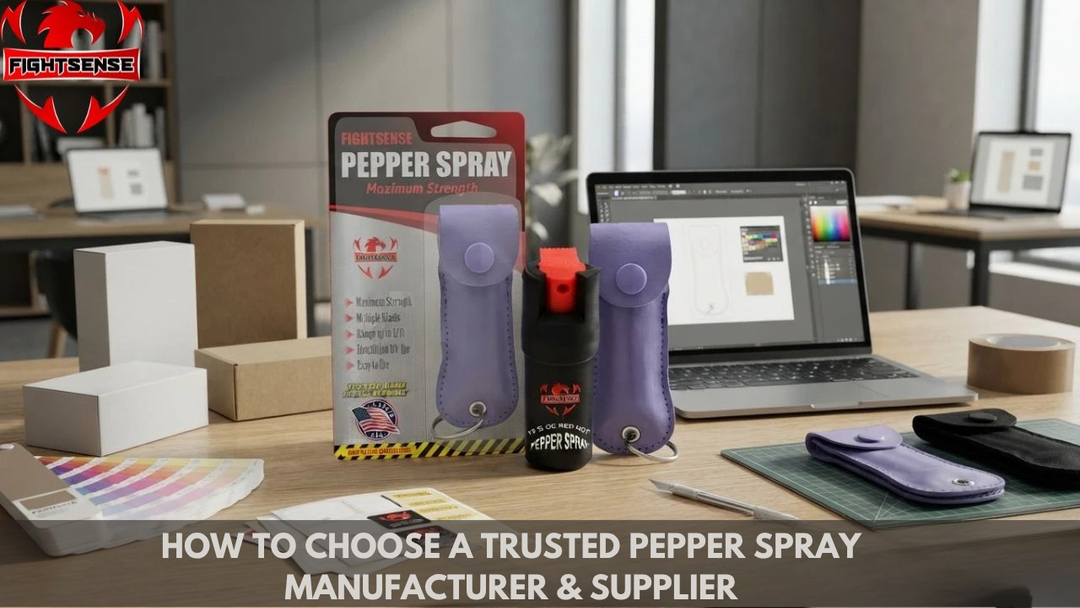
How to Choose a Trusted Pepper Spray Manufacturer & Supplier
Finding the right pepper spray manufacturer or wholesale partner is crucial for businesses, retailers, and security agencies aiming to deliver effective, non-lethal self-defense tools. When end-users rely on personal safety equipment, they need absolute confidence in its reliability and stopping power.
However, sourcing high-grade self-defense products requires understanding industry benchmarks, vetting reliable manufacturing partners, and evaluating key supply chain factors. In this guide, we break down the essentials of selecting a top-tier supplier, streamlining production insights, and securing the right partner for your brand.
What Is Pepper Spray and Why Is It Essential for Personal Safety?
Pepper spray is an effective non-lethal self-defense product that is composed of Oleoresin Capsicum (OC), an active substance extracted from natural chili peppers. When deployed, it produces instant inflammation of the eyes, coughing, and temporary blindness so that people can escape safely from dangerous situations. Security brands and distributors that supply high-grade self-defense item to stores are providing end users with solid, field-tested protection they can trust in critical circumstances.
The Streamlined Pepper Spray Manufacturing Process
Knowing how a self-defense spray is made might help customers evaluate manufacturing quality without wading through intricate chemical language.
- OC Extraction & Purification: Mature chili peppers are collected and subjected to a solvent extraction process to produce Oleoresin Capsicum (OC), which is then purified in laboratory settings to separate capsaicinoids.
- Formulation & Blending: The pure extract is combined with a liquid carrier, a dye for UV identification, and propellant agents.
- Canister Filling & Pressurization: Automated machinery fills aluminum or steel canisters, pressurizing them with inert gases to ensure uniform spray performance.
- Valve Assembly & Quality Control: Safety flip-tops, nozzles & actuators are securely mounted and then subjected to rigorous leak and pressure testing.
How to Choose the Right Pepper Spray Manufacturer for Your Business Needs
This is the core focus of your sourcing strategy. Selecting a dependable manufacturing partner requires a structured evaluation checklist to protect your brand reputation and ensure product reliability.
- Verify Regulatory Compliance: Ensure the production facility meets international safety standards, local legal limits, and holds necessary certifications (such as ISO quality management or law enforcement compliance).
- Assess Batch Consistency and Testing: A reputable pepper spray supplier must conduct High-Performance Liquid Chromatography (HPLC) testing on every production run to verify exact active ingredient percentages.
- Evaluate Private Labeling and Customization: Look for a private label pepper spray manufacturer that offers custom branding, logo printing, custom packaging, and various canister sizes (keychain, duty belt, or concealed models).
- Analyze Production Scale and Minimum Order Quantities: Confirm whether the wholesale pepper spray manufacturer has flexible MOQs that align with your business capacity—whether you are launching a startup brand or scaling enterprise distribution.
- Review Supply Chain and Lead Times: Ensure your chosen bulk pepper spray supplier maintains stable shipping logistics, reliable inventory levels, and predictable customs clearance times.
Key Quality Standards and Formulation Metrics
When evaluating a manufacturing plant, these are important performance criteria to look for:
- Major Capsaicinoids (MC): This is the true measure of stopping power and is normally in the range of 1.2% to 1.4% in defense-grade formulations.
- SHU Rating: High-grade formulations can range from 2 million to 5 million Scoville Heat Units.
- Shelf Life: Reliability in the industry tends to be about 3 to 4 years.
- Spray Patterns: Ballistic stream, gel, or aerosol fog choices available.
Comparison: Certified Production vs. Low-Quality Alternatives
|
Feature |
Certified Manufacturing |
Low-Grade Production |
|
Capsaicinoid Consistency |
Uniform laboratory-tested potency |
Unpredictable heat levels |
|
Container Durability |
Leak-proof, high-pressure aluminum |
Prone to sealing failures |
|
Actuator Safety |
Reliable flip-top or twist-lock |
Risk of accidental discharge |
|
Shelf Life |
Guaranteed 3–4 years |
Degrades rapidly over time |
Step-by-Step Sourcing Guide for Businesses
- Define Your Product Specifications: Determine whether you need pocket keychains, police-grade duty canisters, or gel formulas.
- Shortlist Verified Suppliers: Research global manufacturers with proven track records in personal safety equipment.
- Request Product Samples: Test the spray distance, canister grip, and stream accuracy firsthand.
- Audit Safety Certificates: Review compliance documentation and lab assay reports.
- Finalize Private Labeling: Add your branding, custom packaging, and user instructions.
Expert Tips for Quality Assurance
- Always ask for a High-Performance Liquid Chromatography (HPLC) test report to verify the actual proportion of the active ingredient.
- Test canister valve reaction time at simulated severe temperatures (hot and cold resistance).
- But there are firms like FightSense who are filling this gap by giving lab-verified personal safety solutions ready to go to market without the factory-scale production problems.
FAQs:
Q: What is the minimum order quantity for custom manufacturing?
MOQ’s can be anywhere from zero to hundreds of thousands depending on whether you are buying basic units or a completely customized private label pepper spray. Good providers will frequently have expandable tiers so you can grow with them.
Q: Can I put my own brand logo on a wholesale order?
Yes, most professional wholesale pepper spray manufacturing facilities offer full private-labeling services, allowing you to specify packaging, colors, and branding features.
Q: What qualifications should a good pepper spray vendor possess?
Look for ISO certified production plants, quality control documents, and compliance with local regulatory criteria for self-defense equipment.
Q: How can I buy bulk pepper spray for my retail business?
You can also work directly with a bulk pepper spray supplier or factory that specializes in pepper spray to get volume pricing, custom packaging, and reliable supply chain logistics.
Q: Pepper spray for professionals typically has a shelf life of 3-5 years.
Most quality pepper sprays will be at full strength for 3-4 years after the date of manufacture.
Q: How is the efficacy of a pepper spray compound tested?
Strength is determined by the percentage of Major Capsaicinoids (MC), not merely Scoville Heat Units, ensuring actual stopping power.
Summary:
Securing a reliable partnership with a professional pepper spray manufacturer is the foundation of a successful personal safety brand. By prioritizing strict quality standards, verified capsaicinoid potency, and transparent supply chains, you can deliver dependable products that protect end-users when it matters most.
Whether you are scaling an existing catalog or launching a new line of private label security tools, choosing the right pepper spray supplier ensures long-term trust, brand growth, and market success.
Disclaimer:
Pepper spray products are subject to local laws and regulations. Users and distributors should always follow applicable legal requirements and manufacturer guidelines.