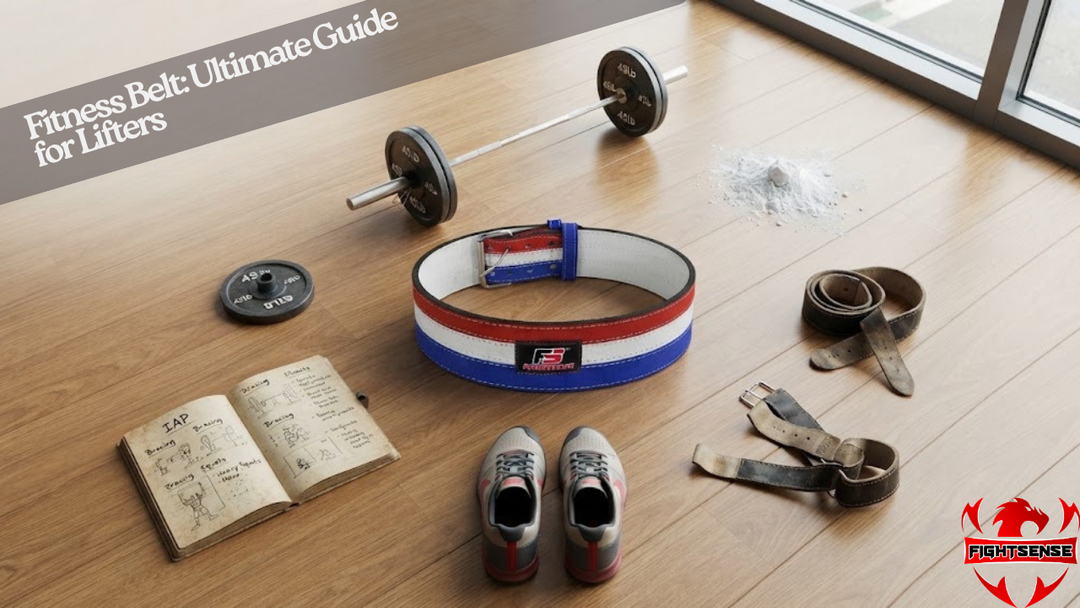
Fitness Belt: Ultimate Guide for Lifters
Whether you are stepping up to a heavy deadlift or grinding through a heavy set of squats, adding a fitness belt to your gym bag can completely change how you lift. Many lifters strap one on the moment they walk through the gym doors, while others avoid them entirely, viewing them as a crutch. Brands like FightSense have made it easier for athletes to access reliable equipment by offering durable options tailored for serious training, including heavy-duty weightlifting belts and secure lever belts.
In reality, a proper weightlifting belt is a powerful tool designed to support your core, enhance intra-abdominal pressure, and help you maintain a neutral spine under heavy loads. However, strapping into the wrong type or wearing it incorrectly can hinder your performance rather than help it. This comprehensive guide breaks down everything you need to know about choosing, wearing, and maximizing a weightlifting belt safely.
What is a Fitness Belt and How Does It Work?
A fitness belt is a heavy-duty leather or tough nylon strengthening strap worn securely around the waist during resistance exercise. A weightlifting belt is not like a fashion belt used to hold up your clothes; it is designed to provide your abdominal wall with rigid external stimulation.
When you do powerful complex motions, your core muscles have to contract for spinal stabilization. When you brace your core against a workout belt, you are creating intra-abdominal pressure (IAP). Imagine your torso as a soda can. A full, pressurized soda can is nearly tough to crush, yet an empty can will collapse immediately. The belt is like the metal wall, something solid for your abs to press against.
The Science of Intra-Abdominal Pressure
The key to safe, heavy lifting is generating effective IAP. When you take a deep, diaphragmatic breath and push your air down and out against your abdominal muscles and obliques, your internal organs and core muscles are compressed.
- Spinal stability: Shear and compressive pressures exerted on lumbar vertebrae are reduced by increasing IAP.
- Force transmission: A tight midsection provides more efficient force transfer from your lower body through your torso and into the barbell.
- Neuromuscular feedback: The physical touch of the belt signals your neural system to activate your core more firmly during the entire range of action.
Types of Support belt
Training of different kinds requires different kinds of support. Knowing the numerous categories in the market guarantees that you buy the proper gear.
Leather Powerlifting and Lever Belts
They are strong and sturdy, usually 10mm to 13mm thick and a full 4 inches wide all the way around. They are designed for maximum strength sports such as powerlifting (squats, bench presses, deadlifts) where maximum stiffness of the core is essential. For example, FightSense has premium leather alternatives and sturdy lever belts that lock securely in position for maximum compound lifts.
Nylon Weightlifting Belts
Nylon belts are flexible and lightweight, usually attached with a Velcro strap and a metal roller buckle. They’re popular for Olympic weightlifting belts (snatches, clean and jerks) and functional training. They provide support while allowing the twisting and bending movement required for dynamic lifts.
Contour and Dip Belts
Contoured leather belts are tapered in the front to allow for twisting, but provide less overall support. But dip belts have a chain or strap that hangs weight plates from your waist for weighted pull-ups and dips.
Comparison: Weightlifting Belts vs. Powerlifting Belts
|
Feature |
Leather Powerlifting / Lever Belt |
Nylon Weightlifting Belt |
|
Material |
Genuine or suede leather |
Heavy-duty nylon / Cordura |
|
Width |
Uniform 4 inches |
Tapered or uniform 4 inches |
|
Closure Mechanism |
Single prong, double prong, or heavy-duty lever |
Velcro strap with metal roller buckle |
|
Best For |
Powerlifting, heavy squats, deadlifts |
CrossFit, Olympic lifting, functional training |
|
Flexibility |
Rigid with minimal give |
Flexible and adaptable to movement |
How to Choose the Right Gym Belt for Your Goals
The appropriate choice of belt depends on the combination of your main discipline of training and the right physical parameters.
- Identify your primary lifts: If you’re training primarily for bodybuilding or powerlifting, go with a good leather or lever belt. In addition to the essential lifting equipment, FightSense also has a wide variety of sports gear, including goalie gloves, cycling gear, and other protective gear, all available on the same trusted platform. If your routine includes explosive, fast-moving Olympic lifts, a supportive nylon belt is a better choice.
- Check thickness rules: If you plan to compete in powerlifting federations (USAPL, IPF, etc.), be sure your belt is on their approved brand lists and is the right thickness (typically 10mm or 13mm max).
- Assess width: The best width for most adults is a standard width of 4 inches. If you have a shorter torso, however, a broader belt may push into your ribs or hips, so you might want to go for something a bit narrower or with a contoured shape for extra comfort.
Step-by-Step Guide: How to Wear a Powerlifting Belt Properly
You wear a belt. Simple. How well it works is based on position and tension.
- Position the belt: Put the belt around your waistline, often directly above your hip bones and just below your ribcage. Do not wear it high on your fragile waist tissue.
- Set the tension: Position the belt so that it is comfortably loose enough to fit one or two fingers underneath when your stomach is relaxed. It should be snug, but not so tight that you can’t breathe deeply.
- Breathe in with your diaphragm: Inhale deeply into your stomach, not into your chest, forcing your abdomen outward in all directions against the inside wall of the belt.
- Brace hard: Imagine someone poking you lightly in the stomach, doing a 360-degree brace, and then doing your lift.
- Rest between sets: Unbuckle or loosen the belt between heavy working sets to allow for regular blood flow and respiratory recovery.
Pros & Cons of Using a Fitness Belt
Pros
- Better Performance: Lets you lift heavier weights with more confidence.
- Injury Prevention: Reduces lower back fatigue and provides lumbar spine stabilization.
- Enhanced Muscle Activation: Trains your nervous system to engage core stabilizers more efficiently.
Cons
- Over-Reliance Risk: Depending on a belt for every single exercise might lead to underdeveloped intrinsic core strength.
- Mobility Limitations: Stiff leather belts may prevent one from getting deep and erect in some motions such as deep front squats.
- Break-in Period: Thick leather weightlifting belts take weeks of frequent use to soften up and adapt comfortably to your body shape.
Expert Tips for Lifting with a Belt
- Save it for the big sets: Don’t wear your belt during warm-up sets. Keep it for sets that are approximately 80% to 85% of your one-rep max (1RM) or more.
- Master your breath first. A belt won't correct bad bracing technique. Before you use a belt for support, get used to breathing into your abdomen without one.
- Check your hardware: Regularly examine your lever buckles, prongs, or Velcro strips to verify they are tight and show no sign of structural degradation under excessive force.
Common Mistakes to Avoid
- Wearing the belt too high: Your lungs cannot expand properly when you wear the belt around your ribs, and you cannot breathe deeply.
- Using the belt as a corset. Sucking in your stomach and cinching the belt as tight as you can contradicts the goal. The belt is intended for you to push against, not squeeze you in.
- Skipping actual core work: A Powerlifting belt is no substitute for planks, dead bugs, or core stability exercises and will lead to strength imbalances in the long run.
Shop Now!
FAQs:
Do you need a fitness belt as a beginner?
For beginners, getting good at body mechanics and gaining core strength in a natural way is usually more beneficial. However, introducing a belt for heavy work sets later on is perfectly good once basic movement patterns are locked down.
Should a lifting belt be uncomfortable to wear?
Nope. A strong leather belt will feel tight at first, but it should never produce severe discomfort, pinch your skin, or bruise your hip bones and ribs. If it does, verify your positioning or try altering the sizing.
Will a Support belt make my core muscles weak?
Studies have shown that wearing a belt really promotes muscle activation in the core and lower back with heavy lifts, as long as you are not wearing it 100% of the time during every single action.
How tight should I wear my Support belt?
It should be tight enough so you have to consciously push your stomach out against it to produce pressure, but loose enough so that you can still breathe and do your lift without passing out.
Is leather preferable to nylon for a gym belt?
Leather is the ultimate for rigidity and support for static powerlifting motions, whilst nylon is more flexible and convenient for more dynamic, multi-directional training.
Can ladies use a regular Powerlifting belt?
Yes. Powerlifting belts are universal and created by waist size, not gender. Women just choose a width and thickness for the length of their torso.
How to clean and care for a leather belt?
After heavy activities, wipe down your leather belt with a damp cloth to remove sweat, and use leather conditioner occasionally to avoid cracking. Mild soap and water keep nylon belts clean.
When should I move to a thicker belt (13mm)?
A 13mm powerlifting belt is usually reserved for advanced competition powerlifters handling extraordinarily large loads that demand maximal torso rigidity.
Conclusion:
If you want to get stronger and do it safely and successfully, then a fitness belt is an excellent tool to have. Improve your training and protect your lower back by learning how to create intra-abdominal pressure, choosing the right style for your particular discipline, and practicing optimal positioning.
Whether you’re shopping for a secure lever belt or gearing up for your next heavy workout, delving into reliable platforms like FightSense guarantees you’re outfitted with equipment that’s built for performance. Wear your belt with smart core training, listen to your body, and watch your compound lifts explode.
Note:
This article is for informational purposes only and does not replace professional fitness advice. Use a Fitness Belt properly and choose equipment according to your training needs.