
Distributors Wholesalers and Retailers Roles in Business
5th May 2025
How do things make their way to store shelves or websites that sell them? Distributors wholesalers and retailers are all part of the supply chain that is responsible for the production.
The process by which commodities are transferred from manufacturers to consumers can be better understood if you have a solid understanding of their functions.
Key Notes
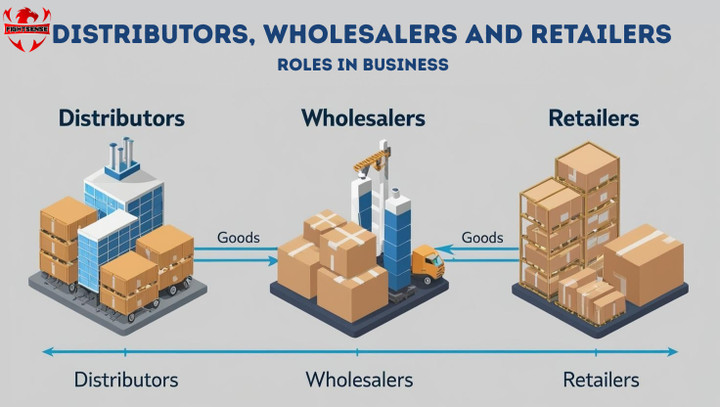
- There are three separate roles that are played by distributor wholesaler retailer.
- Distributors make large purchases and then sell directly to wholesalers or retailers.
- Discounted pricing is offered to retailers by wholesalers.
- Retailers sell their products to customers directly.
- It enables organizations to optimize their operations and provide competitive pricing.
Principal Distinctions: The relationship between distributors wholesalers and retailers
- Distributors are typically responsible for purchasing products in large quantities from manufacturers and offering other services.
- Retailers buy in larger numbers from wholesalers, but wholesalers offer smaller as well as large quantities to retailers at reduced prices.
- Retailers are the companies that customers go to in order to purchase things at deals online, whether they do so in-store or online.
Assuring that the items make it from the production to your hands is the responsibility of each individual, who plays a distinct and crucial part in the product journey.
Wholesaler, Distributor and Retailer Difference?
Although each of these phrases is a component of the retail ecosystem, their functions are separate from one another, and they help to grow the business. Take a glance at distributors wholesalers and retailers to see how each one functions:
1. Distributors are considered to be the middlemen
What do distributors do? Wholesalers and retailers are the customers that wholesale distributors go after after purchasing products in large quantities from producers.
The timely delivery of huge volumes is ensured by their management of logistics, warehousing, and large volumes.
By way of illustration, we are dependent on distributors in order to supply fitness centers and sports retailers with high-quality fitness products.
2. Wholesalers are sellers of goods in bulk
Wholesalers purchase goods in bulk from manufacturers or wholesalers and then sell them to retailers in smaller quantities, charging a markup for the difference.
Additionally, they do not provide services like as logistics or warehousing, in contrast to distributors near me.
You can purchase bulk items at lower prices when you buy from Amazon wholesale distributors, for instance. This enables wholesalers to pass on the savings to retailers to save money.
3. The final stop for customers is the retail establishment
In either traditional brick-and-mortar storefronts or via the internet, retailers sell their wares to end users directly.
In order to make things available for purchase, they first purchase them from wholesalers or distributors, then mark up the products' prices, items like pen stun guns.
For instance, if you purchased our gym product, it was most likely from a shop that obtained it from a wholesaler or distributor. This made it simple for you to acquire the product for self-defense.
Why is it Significant to Have an Understanding of These Roles?
In wholesaler, retailer vs distributor play, businesses are able to improve their business decisions around sourcing, and consumers are able to better comprehend the value chain that lies behind their purchases.
Businesses that require items such as gym equipment and safety gear we offer a wide variety of products, which might benefit from the access that wholesale distributors can provide to quality products like stun guns at lower prices.
My own personal experience
I remember that when I initially started purchasing products for my company, I was perplexed about the responsibilities that distributors wholesalers and retailers play in the supply chain.
The prompt delivery of gym and safety items like pepper spray was secured by my partnership with Fightsense, which allowed me to maintain the satisfaction of my consumers.
My experience has shown me that collaborating with the appropriate wholesalers and retailers enables a more streamlined operation and more cost-effective pricing compared to alternative options. We are your right partner.
Conclusion
Distributors wholesalers and retailers collaborate to ensure that products are effectively delivered to customers. Each has a distinct function, ranging from purchasing in bulk to making final sales.
Knowing how things reach you can be helpful. This is true whether you are purchasing gym equipment from Fightsense or sourcing from wholesale wholesalers on Amazon.
Note: The sole objective of this blog is to provide information. Therefore, before making any decisions, it is important to conduct a study and get the advice of professionals.
FAQs
- What are the key differences between wholesalers and distributors?
Distributors sell in large numbers to wholesalers or retailers, whereas wholesalers sell smaller quantities to shops that offer consumer goods.
- What are the workings of Amazon's wholesale distributors?
They make bulk purchases from producers and then offer their products to shops or sellers on Amazon.
- Is it possible for me to sell directly to distributors?
Certainly, but some would need business registration or specific volume criteria.
- What is the importance of retailers?
Retailers are the ones who offer things to customers directly, making them available to customers either in-store or online.