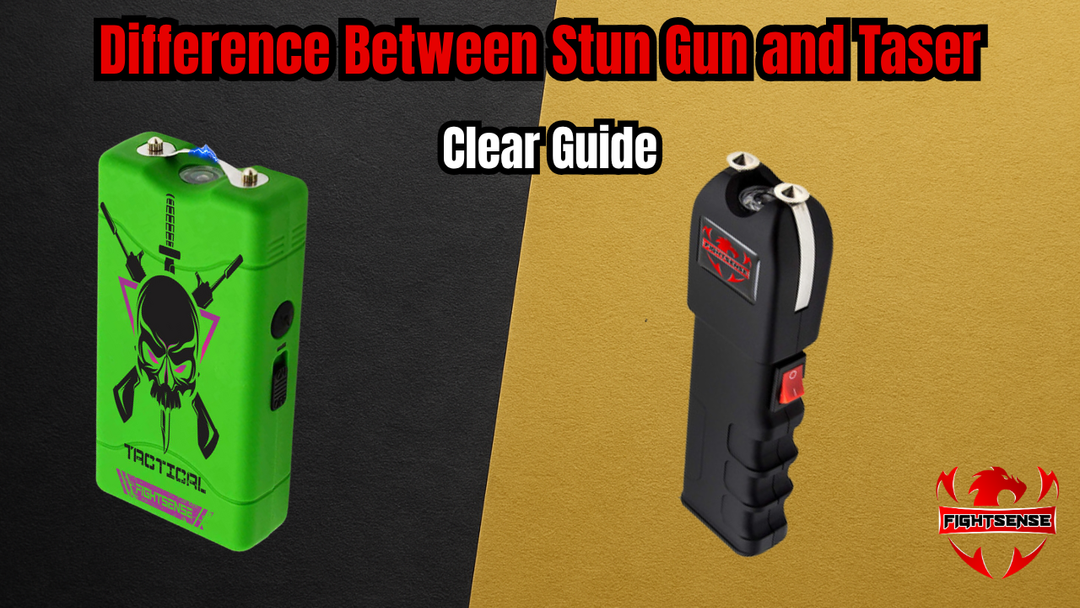
Difference Between Stun Gun and Taser: Clear Guide
Many people ask, what is the difference between stun gun and taser? Although these self-defense tools are often confused, they work in different ways and are designed for different situations.
This guide explains the key differences, compares their features, and helps you decide which option best fits your personal safety needs.
Keynotes
- Stun guns need direct contact; Tasers work from up to 35 feet.
- Choose a stun gun or Taser based on carry style and range needs.
- Stun guns suit commuters; Tasers are ideal for joggers or home use.
- Tasers immobilize longer; stun guns work only on contact.
- FightSense stun guns are safe, rechargeable, and legally compliant.
How a Taser and a Stun Gun Work
Understanding the difference between a TASER and stun gun begins with how each device functions. A TASER launches probes connected by wires, allowing it to affect a person from several feet away.
A stun gun, on the other hand, requires direct contact with the attacker to deliver an electrical shock.
Key Differences
- TASERs work from a distance.
- Stun guns require close contact.
- Both are designed as less-lethal self-defense tools.
- Laws governing each device vary by location.
- Training and responsible use are recommended.
Use Cases: Real-World Practicality of Taser vs Stun Gun
When assessing the difference between stun gun and Taser, real-life context plays a vital role. Your personal lifestyle, daily routine, and environment determine which self-defense tool is more effective for you.
Let’s break down tazer vs stun gun or what is the difference between a taser and stun gun and what's the difference between a taser and a stun gun based on real-world scenarios:
Stun Gun: Compact Defense for Everyday Situations
A FightSense stun gun is perfect for those needing something lightweight, discreet, and reliable at close range:
- Ideal for commuters who walk through busy terminals or dark alleys.
- Athletes and joggers benefit from its portability during early morning or late-night runs.
- Drivers can store it in the glove box for quick access at traffic stops or breakdowns.
- Lone travelers or students find comfort in having a compact stun gun on hand in unfamiliar areas.
- Perfect for indoor defense, such as apartments, dorm rooms, or inside elevators.
Taser: Tactical Advantage in Open or High-Risk Areas
If you face threats where distance and reaction time matter, a Taser is your better choice:
- Useful in parking lots, where attackers may approach from several feet away.
- Great for home defense, especially in larger spaces like hallways or front yards.
- Effective for security professionals needing to subdue threats without close contact.
- Helpful for women or seniors who may not want to engage physically with a threat.
- Valuable in rural areas where backup may not be immediately available.
Detailed Side-by-Side Table
A clear table helps highlight the difference between stun gun and taser and supports visual comprehension:
|
Feature |
Stun Gun |
Taser |
|
Contact Method |
Direct skin contact |
Projectiles with wires (10–35 ft range) |
|
High-voltage, short-duration |
Moderate-voltage sustained pulses |
|
|
User Range |
Must be within arm’s length |
Remote deployment at distance |
|
Effect Duration |
Stops when contact ends |
Continues for 5–20 seconds after deployment |
|
Portability & Size |
Compact, discreet |
Bulkier, cartridge-based |
|
Maintenance & Cost |
Requires replacement cartridges and wires |
This table visually reinforces the differences and supports indexing, repetition of difference between stun gun and taser in the header contextualization.
Safety, Duration & Recovery Effects: Stun Gun vs Taser Gun Breakdown
Understanding the difference between stun gun and taser gun vs taser goes beyond immediate function, it’s about safety, duration of incapacitation, and how the body reacts post-use.
People who care about safety should look at what is the difference between taser and stun gun and how each device affects pain, healing, and the body's overall response.
Duration of Effect:
-
Stun Gun:
- Can't do anything when they get close.
- The jolt stops right soon when the gadget is pulled away.
- It usually only lasts a few seconds, which gives you time to run away.
-
Taser:
- Fires electrodes that are connected by wires from as far away as 15 feet.
- Automatically sends waves for up to 30 seconds, even if the trigger isn't held down.
- So you have time to run or ask for help after you launch.
Recovery and Pain Impact:
-
What is the difference between a stun gun and a Taser in recovery?
- Stun guns don't last long; the effects usually wear off in minutes, leaving just slight muscle discomfort.
- The taser can hurt nerves and muscles farther down, which could make you fatigued for a long time.
-
Pain Level:
- Stun guns hurt a lot and soon.
- When you use a Taser, your whole body locks up quite tightly, which people often say makes things more complicated.
Potential Side Effects:
Both devices are generally safe when used as directed, but:
- When stun guns are used, there may be burns or swelling.
- The darts in tasers can break the skin and make muscles feel a little sore.
Safety Guidelines & Risk-Management Tips:
- Always aim for places that won't kill you, such as the shoulder or thigh.
- You shouldn't touch someone with a stun gun versus taser for more than a few seconds at a time.
- You shouldn't use tasers near water or on persons who have pacemakers.
- Post-use recommendations:
- Let the person rest for 15 to 30 minutes.
- If you need to, put cold packs on the area to help with the swelling.
- Watch your muscles and respiration for indicators of trouble.
Safety and Legal Considerations
Before purchasing either device, check your local laws. Some states have specific regulations for owning or carrying stun guns and tasers. Always use these tools responsibly and only for self-defense situations.
Technical & Maintenance Comparison
To clearly highlight what is the difference between a stun gun and taser, consider maintenance needs. The FightSense high-end stun pistol doesn't need batteries or wires. You only have to charge it via USB every few weeks.
A stun gun vs tazer, on the other hand, needs new ammo, tests, and checks to make sure the wires are still OK. This section offers six lines of extra care instructions that assist consumers pick the proper device by helping them compare costs and how easy it is to use.
TASER vs Stun Gun: Which Is Better?
When comparing TASER vs stun gun options, there is no single best answer. A TASER offers distance, while a stun gun is typically more compact, affordable, and easier to carry every day.
Your choice should depend on your personal safety needs, budget, and local laws.
Factors to Consider
- Everyday portability
- Ease of operation
- Local legal restrictions
- Intended use
- Product quality and reliability
FightSense Stun Guns: Reliable Everyday Protection
If you decide a contact device fits your needs, FightSense offers dependable stun guns designed for everyday personal safety.
Their compact design, rechargeable models, and built-in safety features make them practical for commuting, traveling, or daily carry.
Why Choose FightSense
- Compact and lightweight
- Easy to carry
- Built-in safety switch
- Rechargeable options
- Designed for everyday use
- Dependable construction
How They Work: Breaking Down the Difference Between Stun Gun and Taser
Understanding the difference between stun gun and Taser starts with how these self-defense tools operate. Both are non-lethal weapons, but their mechanisms and usage are quite distinct.
Here’s a practical breakdown to help you fully grasp what is the difference between a stun gun and a Taser or taser stun gun difference and vice versa.
Stun Gun: Close-Range Defense
- Needs to be close to the attacker to work.
- Gives a painful high-voltage shock that makes muscles lose their capacity to control themselves.
- Best for dangers that happen straight away and are close by.
- It is compact and light enough to put in a pocket, purse, or bag.
- It can't be utilised from far away, which means you might have to get close.
Taser: Distance-Based Control
- Fires two small dart-like electrodes attached to wires.
- The person who has it can stop an assault from up to 15 feet away.
- Makes it impossible for the target to move by messing with their neuromuscular system.
- Good for police officers or those who need to defend themselves at a distance.
- They are usually bigger, cost more, and in certain places you need a licence to use them.
Real-World Experience: Choosing the Right Self-Defense Tool
Many first-time buyers are unsure whether to choose a TASER or a stun gun. One commuter compared both options before selecting a compact FightSense stun gun because it was lightweight, simple to use, and easy to carry during evening walks.
While they never needed to use it, carrying a reliable self-defense device provided added confidence and peace of mind.
Why It Worked
- Easy to keep within reach
- Comfortable to carry daily
- Quick to access
- Simple operation
- Helped improve personal confidence
Conclusion
Understanding what's the difference between a stun gun and taser and the difference between a TASER and stun gun helps you choose the right self-defense tool for your lifestyle. TASERs provide distance, while stun guns offer compact, close-range protection.
If portability, ease of use, and dependable performance are your priorities, FightSense stun guns are a practical option. Always learn your local laws and practice safe, responsible use.
Disclaimer
This blog is only for sharing information; it is not designed to give legal or medical advice. There are a lot of varied laws governing stun guns and Tasers in different places.
You should always verify the rules in your area before buying, bringing, or using a self-defence item.
FAQs
1. What is the difference between a TASER and stun gun?
The main difference between a TASER and stun gun is that a TASER can be used from a distance, while a stun gun requires direct contact.
2. Is a TASER a stun gun?
No. Although both are electrical self-defense devices, a TASER is not a stun gun because it works differently and can deploy probes from a distance.
3. Is a stun gun a TASER?
No. A stun gun is not a TASER. A stun gun works only through direct contact with the attacker.
4. What hurts more stun gun or taser?
People often ask, what hurts more, a stun gun or a TASER? Both are designed to temporarily stop a threat, but their effects differ based on the device, placement, and situation.
5. What's the difference between a stun gun and a TASER?
The difference between a stun gun and a TASER is that TASERs fire probes from a distance, while stun guns must touch the attacker.
6. Should I choose a TASER gun vs stun gun?
When comparing TASER gun vs stun gun, consider your local laws, budget, comfort level, and whether you prefer distance or close-contact protection.
7. What is the stun gun TASER difference?
The stun gun TASER difference is mainly their operating range and method of delivering an electrical charge.
8. Are stun guns vs TASERs legal everywhere?
No. Laws regarding tasers vs stun guns vary by state, city, and country. Always check local regulations before purchasing or carrying either device.