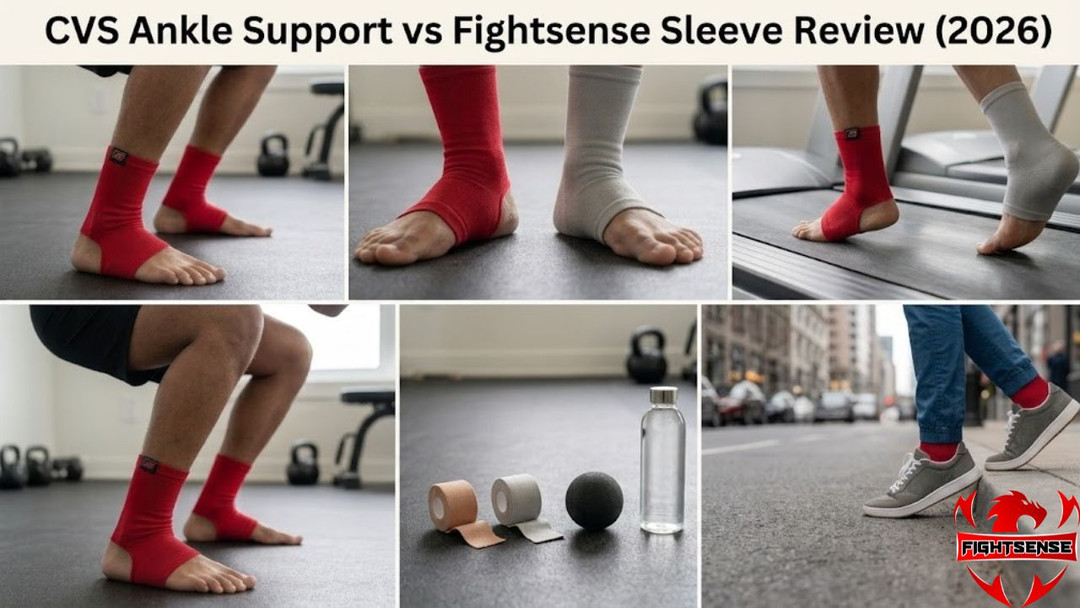
CVS Ankle Support vs Fightsense Sleeve Review (2026)
If you’re deciding whether a standard CVS Ankle Support is enough for your joint pain, one bad step can quickly answer that question. That sudden, sharp twinge midway through a run—or struggling off the curb after leg day—proves how fast ankle instability halts your life, whether from lingering sprains or daily wear-and-tear.
Many grab a quick pharmacy fix, while others choose performance-driven athletic sleeves like Fightsense. But does a budget drugstore option offer real reinforcement, or do high-intensity days demand anatomically engineered gear?
Let’s strip away the marketing hype and test how both perform under real-world pressure.
Key Takeaways:
- Targeted Support: Fightsense locks ligaments with 3D zones; standard sleeves offer basic, flat pressure.
- Faster Reflexes: Advanced compression triggers nerve response to stop rolls before they happen.
- No-Slip Hold: Moisture-wicking fabric prevents slipping inside shoes during sweat.
- Long-Lasting Fit: Athletic elastane holds tight long after basic pharmacy elastic stretches out.
- Smart Choice: Use CVS Ankle Support for casual walks; choose Fightsense for heavy workouts.
What Makes Ankle Stability So Critical for Recovery and Performance?
To understand which sleeve works better, we first need to look at what happens inside your ankle joint when you move. The ankle isn't just a simple hinge; it is a complex intersection of bones, tendons, and ligaments—most notably the anterior talofibular ligament (ATFL), which is the most frequently injured ligament during ankle rolls.
When you strain or sprain an ankle, two major things happen:
- Mechanical Instability: The structural tissues stretch or micro-tear, leaving the joint susceptible to excessive lateral (side-to-side) wobbling under weight.
- Loss of Neuromuscular Feedback (Proprioception): Your brain loses its fine-tuned nerve connection to the joint's position, delaying your natural reflex to catch yourself when your foot lands unevenly.
A properly designed sleeve doesn't just act as a physical brace; it acts as a tactile feedback loop. The continuous physical contact against your skin sends constant sensory signals to your central nervous system, prompting your surrounding muscles to fire faster and stabilize the foot before a roll happens.
How Does CVS Ankle Support Hold Up for Daily Wear?
For millions of people dealing with unexpected joint stiffness, a simple drugstore solution is usually the first stop. The basic CVS Ankle Support line is built around convenience and immediate accessibility.
Design and Material Construction
The standard pharmacy-grade sleeve relies heavily on traditional elastic knit weaving, often blended with basic synthetic yarn. It features an open-heel or continuous slip-on design that provides uniform surface tension across the midfoot and lower shin.
Real-World Performance & Fit
If your goal is light compression to manage mild fluid buildup after standing all day at work, this basic design serves its purpose. It warms the tissue, increases surface circulation, and offers gentle joint awareness.
However, traditional elastic weaves face structural limitations during dynamic movement:
- Uniform Tension Shortfalls: Basic elastic applies the exact same pressure to your bony ankle prominence as it does to soft tissue, which can lead to pinching or slipping during active use.
- Loss of Elastic Memory: Under continuous stretch and sweat exposure, standard elastic threads gradually loosen, reducing structural hold over time.
While an Over-the-counter (OTC) ankle brace is suitable for walking the dog or sitting at a desk during early injury recovery, it lacks the targeted structural tension required for sudden directional changes or heavy weight bearing.
What Makes Fightsense Sleeve Different for Active Movement?
Where basic pharmacy options prioritize low-cost accessibility, Fightsense takes a structural engineering approach to joint protection. Designed around the demands of combat sports, weightlifting, and high-impact athletics, the Fightsense sleeve is built to handle multidirectional shear stress.
Targeted Anatomical Contouring
Instead of relying on a flat, single-paneled weave, Fightsense utilizes 3D circular knitting technology. This allows the fabric to feature differential tension zones:
- High-Density Ligament Bands: Tighter weave density along the lateral and medial walls to support ligament alignment.
- Flexible Joint Zones: Softer, highly elastic panels across the anterior ankle flex-point to allow natural dorsiflexion and plantarflexion without fabric bunching inside your shoe.
Material Durability and Sweat Management
Fightsense incorporates a high-grade Neoprene-Elastane hybrid blend with specialized moisture-wicking channels. Rather than trapping sweat against the skin—which causes slipping and friction blisters—the technical fabric transports moisture away while retaining localized therapeutic warmth deep inside the joint capsule.
Side-by-Side Architectural & Structural Comparison
To visualize how these two options stack up across key performance parameters, here is a breakdown of their structural differences:
|
Performance Metric |
CVS Health Ankle Sleeve |
Fightsense Athletic Sleeve |
|
Primary Design Intent |
Mild compression & short-term relief |
High-load stability, performance & recovery |
|
Weaving Technology |
Standard flat-knit elastic |
3D Circular Anatomical Contour |
|
Compression Profile |
Uniform (Single-gradient) |
Zone-targeted (Graduated structural support) |
|
Lateral Stability |
Minimal (Low resistance to rolling) |
Moderate-High (Reinforced ligament zones) |
|
Moisture Management |
Standard synthetic breathability |
Active moisture-wicking channels |
|
Durability Expectation |
Best for light intermittent use |
Built for repeated high-intensity cycles |
Which Sleeve Provides Superior Stability Under Pressure?
When evaluating pure joint stability, we have to look at how each sleeve responds to mechanical load.
Low-Impact Environment (Office Work, Light Walking)
If you are recovering from minor joint soreness and spend most of your day seated or walking on flat indoor surfaces, a CVS Ankle Support offers adequate light compression. It keeps the ankle warm, reduces minor swelling, and fits comfortably inside casual footwear without adding unnecessary bulk.
High-Impact Environment (Running, Gym Work, Sports)
The moment you introduce dynamic force—jumping, sprinting, or heavy squatting—the mechanical demands on your ankle increase dramatically.
Under active movement, an athletic sleeve like Fightsense shows a clear advantage:
- Lateral Rollover Resistance: The high-density weave along the outer ankle wall helps resist micro-adjustments during heavy landings, helping stabilize the joint before an involuntary roll occurs.
- Proprioceptive Activation: The firm, anatomical compression zone around the Achilles tendon and lateral ligaments provides crisp tactile feedback, helping your body maintain alignment during fatigue.
- In-Shoe Stability: Fightsense's ergonomic heel cup prevents the sleeve from sliding down or rolling up at the arch, maintaining consistent compression throughout long workouts.
If you plan to run, train, or work long shifts on your feet, the higher compression rating and anatomical lock of Fightsense offer far better stability than a standard pharmacy ankle support .
How Do They Compare in Long-Term Comfort and Ergonomics?
A brace can offer great support on paper, but if it pinches your skin, accumulates sweat, or cuts off circulation after an hour, it stays in the gym bag.
Fabric Friction and Chafing
Standard elastic sleeves often rely on stitched edge seams to prevent unraveling. After several hours of continuous wear inside a snug shoe, these thick seams can press into the skin, causing hot spots or red pressure lines.
Fightsense utilizes flat-lock seamless edge stitching. This flush transition allows the sleeve to lay flat against the skin, reducing friction and preventing raw spots along the top of the foot and Achilles region.
Thermal Regulation
While both sleeves trap heat to warm joint fluid (which helps reduce stiffness), basic elastic fabrics can retain moisture, causing the sleeve to slip down the leg. Fightsense uses micro-perforated thermal fabric that maintains therapeutic warmth within the tendon layers while releasing excess humidity, keeping your foot cool and dry.
Conclusion:
Choosing between a standard CVS Ankle Support and Fightsense comes down to your daily activity level. If you just need a budget-friendly fix for light walking or short-term joint stiffness, a basic pharmacy sleeve provides adequate warmth and mild compression.
However, for athletes, heavy workouts, or serious sprain recovery, Fightsense is the clear winner. Its 3D-knit support, durable elasticity, and moisture-wicking fit offer the long-term stability needed to keep your joints protected under pressure.
FAQs:
1. How should an ankle sleeve be washed to keep its elasticity?
Hand-wash in cold water with mild soap and air-dry flat. Avoid high-heat dryers, bleach, and fabric softeners, as heat destroys internal elastane fibers.
2. Can compression sleeves be worn comfortably inside high-top work boots?
Yes. Low-profile, seamless sleeves fit smoothly inside work boots and cleats, preventing skin friction, blisters, and shoe pressure spots.
3. Is it safe to wear an ankle compression sleeve while sleeping?
No. Compression is unnecessary when lying flat because gravity already reduces swelling. Wearing tight sleeves overnight can unnecessarily restrict resting blood circulation.
4. What is the difference between an ankle brace and an ankle sleeve?
Braces use rigid plastic or metal stays to immobilize the joint, while flexible sleeves provide light-to-moderate compression and full structural mobility.
5. How long does a quality compression sleeve retain its tightness?
High-grade athletic elastane holds firm compression for 6 to 12 months of active use, whereas basic elastic knit sleeves loosen much faster.
6. How does heat retention inside a sleeve aid joint recovery?
Trapped therapeutic heat increases localized blood flow, keeping synovial fluid inside the joint warm and pliable, which significantly reduces morning stiffness.
Disclaimer:
This content is for informational purposes only. It is not a substitute for professional medical advice, diagnosis, or treatment. Always consult with a healthcare provider before starting any new treatment or using a recovery product.