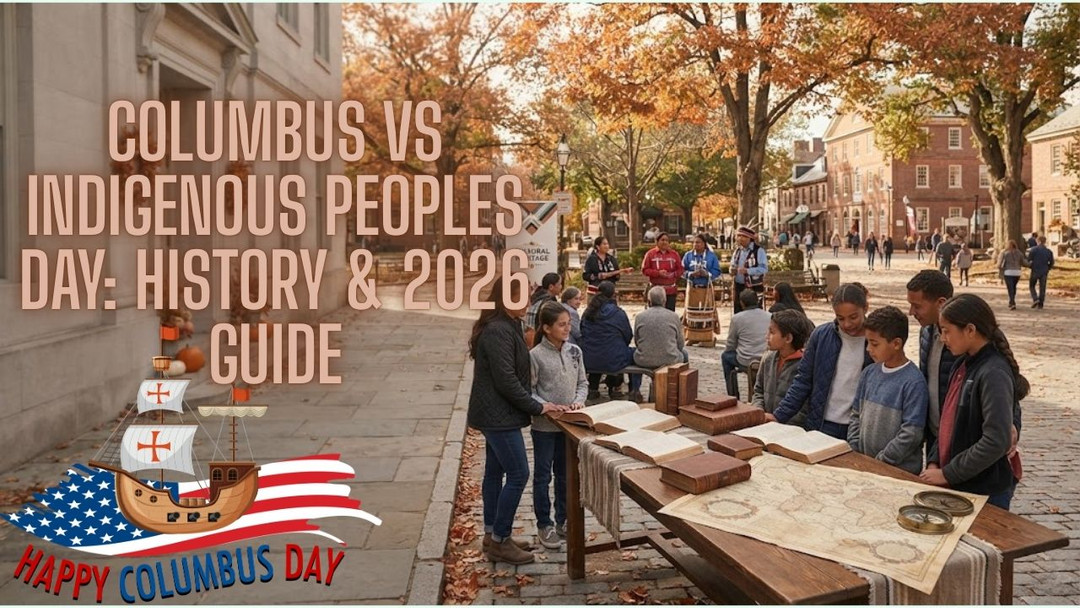
Columbus vs Indigenous Peoples Day: History & 2026 Guide
Every October, Americans see two names connected to the same Monday: Columbus vs Indigenous Peoples Day. While Columbus Day recognizes Christopher Columbus and has strong ties to Italian American heritage, Indigenous Peoples’ Day highlights the history, cultures, and continuing contributions of Indigenous communities. Understanding the difference can help explain why some places observe one, the other, or both.
So, what is the difference between them? Are they separate holidays? Is Columbus Day still a federal holiday? And what should you know about Columbus Day Indigenous Peoples Day 2026?
The answer is more nuanced than simply choosing one name. The two observances reflect different ways of understanding American history, and many states, cities, schools, and communities now recognize one, the other, or both.
What Is Columbus Day?
Columbus Day is a U.S. holiday that commemorates Christopher Columbus's 1492 voyage and his arrival in the Caribbean on October 12, 1492. Importantly, Columbus did not reach what is now the continental United States. His first voyage brought him to islands in the Caribbean, where Indigenous communities were already living.
The holiday developed over many years. Columbus had been commemorated in the United States since the 18th century, while later celebrations became closely connected with Italian American identity and heritage. In 1934, Congress authorized the president to proclaim October 12 as Columbus Day, and the federal holiday was later moved to the second Monday of October.
For many Italian Americans, Columbus Day has historically represented heritage, immigration, and cultural contributions. That part of the holiday remains important to some communities today.
At the same time, historical research has brought greater attention to the consequences of European colonization for Indigenous peoples.
What Is Indigenous Peoples’ Day?
Indigenous Peoples’ Day recognizes the history, cultures, resilience, and continuing presence of Indigenous peoples in the United States.
The term Indigenous peoples refers to the Native peoples whose communities, cultures, and histories existed in the Americas long before European colonization. The Smithsonian's National Museum of the American Indian notes that Indigenous peoples had populated the Western Hemisphere for tens of thousands of years before Columbus arrived.
Indigenous Peoples’ Day grew from decades of activism and efforts to present a fuller account of American history. In 1977, participants at a United Nations conference on discrimination against Indigenous populations in the Americas proposed replacing Columbus Day with an observance focused on Indigenous peoples.
The movement gained momentum in the United States. South Dakota became the first state to replace Columbus Day with a Native American-focused observance in 1990, while Berkeley, California, became the first U.S. city to rename Columbus Day as Indigenous Peoples’ Day in 1992.
The purpose is not simply to rename a holiday. It is also about recognizing that the story of the Americas did not begin with European exploration.
Columbus vs Indigenous Peoples Day: What Is the Difference?
The simplest way to understand Columbus vs Indigenous Peoples Day is to look at what each observance emphasizes.
|
Columbus Day |
Indigenous Peoples’ Day |
|
Focuses on Christopher Columbus and his 1492 voyage |
Focuses on Indigenous peoples and their history |
|
Has strong connections to Italian American heritage |
Highlights Native cultures, communities, and resilience |
|
Is a federal holiday under U.S. law |
Recognition varies by state, city, school, and institution |
|
Traditionally emphasizes European exploration |
Encourages a broader view of the effects of colonization |
|
Observed on the second Monday of October |
Often observed on the same second Monday of October |
These differences do not mean that every person who observes one holiday rejects the other. Some communities recognize both names because they want to acknowledge Italian American heritage while also recognizing Indigenous history.
Why Is Columbus Day Controversial?
Columbus's arrival in the Caribbean in 1492 was a major historical event, but calling it the "discovery" of America overlooks the Indigenous societies that were already established across the Americas. The Caribbean was home to diverse Indigenous communities, including the Taíno, long before Columbus arrived.
How Did European Colonization Affect Indigenous Communities?
European colonization brought profound changes to Indigenous communities. Native peoples experienced violence, forced labor, displacement, warfare, disease, loss of land, and disruption of established communities and traditions. These consequences are a major reason why many people believe October should also recognize Indigenous history, resilience, and continuing contributions.
Why Does the Debate Continue Today?
The discussion is not simply about whether Columbus should be viewed as good or bad. His voyages involved exploration, trade, migration, and European expansion, while the period that followed also brought colonization and serious harm to Indigenous populations. Understanding the debate requires acknowledging these different parts of the historical record rather than reducing the subject to a single viewpoint.
Is Columbus Day a Federal Holiday?
Yes. Columbus Day is a federal holiday in the United States.
Under federal law, Columbus Day is one of the holidays established for federal employees. It falls on the second Monday of October. The U.S. Office of Personnel Management lists Columbus Day as a federal holiday under 5 U.S.C. 6103.
That does not mean every state, city, school, or private company must use the name "Columbus Day." State and local governments can choose different names or observances.
This distinction is important when searching for information about Columbus vs Indigenous Peoples Day. The federal holiday remains legally designated as Columbus Day, while local observance can differ.
Columbus Day 2025: What Happened?
Columbus Day 2025 was observed on Monday, October 13, 2025.
The federal government listed October 13 as Columbus Day on its official 2025 holiday schedule.
Across the country, however, the same date could be described differently. Some places continued to use Columbus Day, while others observed Indigenous Peoples’ Day or another locally recognized name.
This difference is why you may see different holiday calendars depending on where you live.
Columbus Day 2026: When Is It?
Columbus Day 2026 will be observed on Monday, October 12, 2026.
The U.S. Office of Personnel Management lists Monday, October 12, 2026, as Columbus Day on the federal holiday calendar.
Many communities that recognize Indigenous Peoples’ Day will also observe it on October 12 because the observance traditionally falls on the second Monday of October.
For people searching Columbus Day Indigenous Peoples Day 2026, the key point is that these names can refer to observances taking place on the same date, even though their meanings and local recognition may differ.
Why Do Some Places Celebrate Indigenous Peoples’ Day Instead?
The change is largely connected to a desire to recognize Indigenous history from an Indigenous perspective.
For generations, Native people and their advocates have challenged simplified versions of the Columbus story. They argue that celebrating Columbus without discussing colonization can overlook the suffering and displacement experienced by Indigenous communities.
The Smithsonian notes that more states and communities have adopted Indigenous Peoples’ Day either instead of or alongside Columbus Day. The observance emphasizes the resilience and diversity of Indigenous peoples and their continuing presence today.
Berkeley is one well-known example. The city currently lists October 12, 2026, as Indigenous People's Day on its official holiday calendar.
Does Every State Observe the Same Holiday?
No. This is one of the most important things to understand.
The federal government has its own holiday schedule, but states, counties, cities, schools, universities, and businesses can have different policies.
Some jurisdictions continue to call the day Columbus Day. Others use Indigenous Peoples’ Day, Native American Day, or another local designation. Some recognize both.
Because these policies can change, it is best to check the official calendar for your state, city, school, or employer when you need to know whether offices or businesses will be closed.
How Is Indigenous Peoples’ Day Observed?
There is no single way to observe Indigenous Peoples’ Day.
Communities may organize:
- Cultural events and educational programs
- Indigenous art and music activities
- History discussions and public lectures
- Community gatherings
- Traditional cultural demonstrations
- Programs highlighting Native languages and traditions
- Events focused on Indigenous rights and contemporary issues
The goal is generally to move beyond a historical story that ends in the past. Indigenous communities are not simply part of American history; Indigenous peoples and cultures continue to exist and contribute to society today.
If someone says "Happy Indigenous Day," they are usually expressing respect or goodwill toward Indigenous peoples and the observance. The more commonly used formal name in the United States is Indigenous Peoples’ Day.
How Can You Stay Safe at Indigenous Peoples’ Day Events?
Indigenous Peoples’ Day events can include festivals, cultural programs, and community gatherings. Staying aware of your surroundings and having basic safety measures in place can help you enjoy these events with greater confidence. FightSense offers personal-safety products for everyday preparedness, providing an added layer of security when attending public events or going about your daily routine.
Is Indigenous Peoples’ Day the Same as the International Day of the World’s Indigenous Peoples?
No. These are separate observances.
The International Day of the World's Indigenous Peoples is observed internationally on August 9. The United Nations established the date to raise awareness of Indigenous peoples' rights, cultures, and challenges around the world.
In contrast, the U.S. Indigenous Peoples’ Day discussed in relation to Columbus Day is generally observed on the second Monday of October.
The similar names can cause confusion, but they have different histories and dates.
Why Does the Columbus vs Indigenous Peoples Day Debate Matter?
The debate matters because holidays influence how societies remember history.
For supporters of Columbus Day, the observance can represent exploration, Italian American heritage, immigration, and the historical significance of Columbus's voyage.
For supporters of Indigenous Peoples’ Day, the focus is on correcting an incomplete historical narrative and recognizing Native peoples who lived in the Americas long before European arrival.
Both perspectives can be discussed without ignoring historical evidence. Understanding the controversy does not require erasing history. Instead, it allows people to examine more than one part of the story.
A more complete account can recognize Columbus's voyage as a major historical event while also acknowledging the Indigenous societies that existed before 1492 and the serious consequences of European colonization.
Columbus Day vs Indigenous Peoples Day 2026: What Should You Remember?
For Columbus Day Indigenous Peoples Day 2026, remember these key facts:
- Date: Monday, October 12, 2026
- Columbus Day: A federal holiday established under U.S. federal law
- Indigenous Peoples’ Day: An observance recognized by an increasing number of states, cities, schools, and communities
- Same date: Both are commonly observed on the second Monday of October
- Main difference: Columbus Day centers on Columbus and his legacy, while Indigenous Peoples’ Day centers on Indigenous peoples, cultures, history, and resilience
- Local rules vary: The name and official observance can differ depending on where you live
Understanding the difference helps explain why two names can appear on calendars for the same October date.
Final Thoughts
The discussion around Columbus vs Indigenous Peoples Day reflects a larger conversation about how American history is remembered and taught.
Columbus's 1492 voyage changed the course of world history, but it did not mark the beginning of human history in the Americas. Indigenous peoples had established communities, cultures, languages, trade networks, and traditions long before European arrival.
Today, some Americans continue to observe Columbus Day, while others observe Indigenous Peoples’ Day. Some recognize both. Knowing the history behind these choices can make October's observance more meaningful and help create a fuller understanding of the people and events connected to it.
FAQs
How do schools recognize Indigenous Peoples’ Day?
Schools may recognize Indigenous Peoples’ Day through lessons, cultural programs, history discussions, library resources, and activities that teach students about Native communities and their contributions.
Are banks closed on Indigenous Peoples’ Day?
Bank closures depend on the institution. Because Indigenous Peoples’ Day is not a separate federal holiday designation, banks may follow their own operating schedules. Customers should check with their local branch.
Do businesses close for Columbus Day?
There is no universal rule requiring private businesses to close for Columbus Day. Individual employers decide whether to remain open, change hours, or give employees the day off.
Which states recognize Indigenous Peoples’ Day?
Recognition varies across the United States. Some states officially recognize Indigenous Peoples’ Day, while others continue to use Columbus Day or recognize both. State and local policies can change over time.
What are common Indigenous Peoples’ Day activities?
Common activities include cultural exhibitions, educational workshops, Native American history programs, community events, traditional arts demonstrations, and discussions about Indigenous heritage.
How can people respectfully observe Indigenous Peoples’ Day?
People can observe the day by learning from reliable Indigenous-led sources, attending local cultural events, supporting Indigenous artists and organizations, and learning about the history of Native communities.
Is Indigenous Peoples’ Day recognized nationwide?
No. There is no single nationwide requirement that every state or local government use the name Indigenous Peoples’ Day. Recognition and terminology vary between jurisdictions.
Why do some Italian Americans support Columbus Day?
For many Italian Americans, Columbus Day has a connection to cultural heritage and the history of Italian immigration and discrimination in the United States. Community celebrations may focus on Italian American identity and contributions.