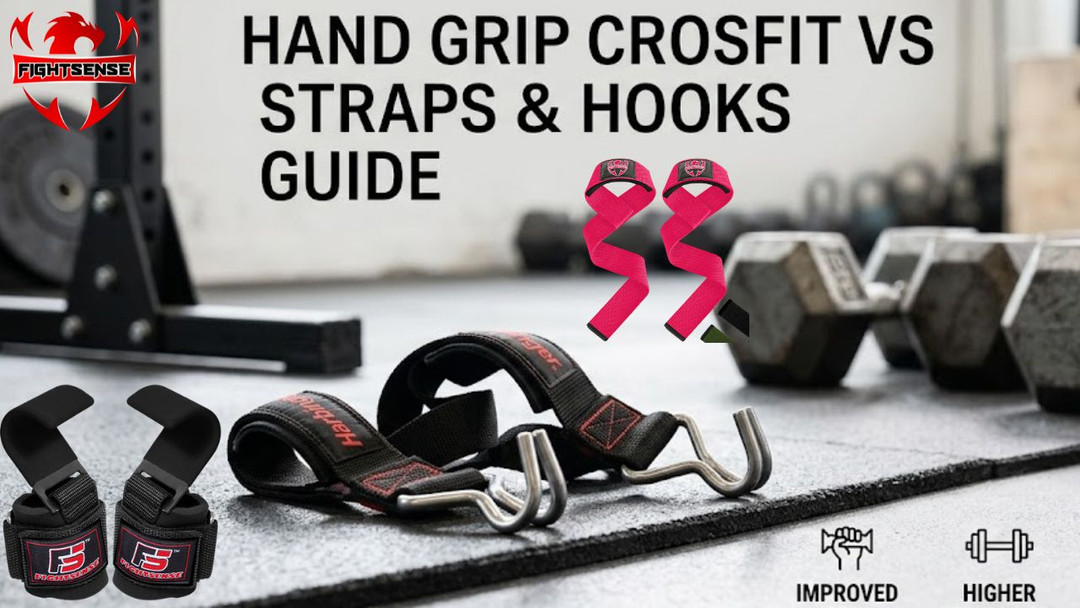
Hand Grip CrossFit vs Straps & Hooks Guide
Confused between Hand Grip CrossFit, straps, or hooks? Learn when to use each, build stronger grip, and lift heavier with the right strategy.
CrossFit grip training training is something you’ll notice immediately when you walk into any serious gym or CrossFit box. Some athletes rely purely on their raw grip, chalked hands locked onto the bar with zero assistance. Others wrap straps tightly around their wrists or use hooks to move heavier loads with ease.
So, which approach is actually better?
If you’re trying to improve performance, build real strength, and avoid plateaus, this isn’t just a small decision—it’s a training philosophy.
In this pro-level guide, we’re going deep into CrossFit grip training training vs weight lifting straps and hooks, and where Fightsense gear fits into the equation. By the end, you’ll know exactly what to use, when to use it, and how to maximize results without compromising long-term strength.
Keynotes:
- Hand Grip CrossFit builds real functional strength, while straps and hooks are only support tools.
- Overusing straps can slow down grip development, so they should be used strategically, not always.
- Hooks remove grip demand almost completely, making them less useful for long-term strength training.
- Best performance comes from balance—train natural grip and use for heavy sets.
- Consistent grip training improves overall lifting power, endurance, and control in CrossFit movements.
Why Grip Strength Is the Hidden Limiting Factor?
Before we start comparing tools, let’s address the actual problem:
Your grasp is typically the weakest link in your entire kinetic chain.
Maybe you have the strength to deadlift heavy. Perhaps your back is strong enough to pull a heavier weight. But if your hands fail you, you’re done.
This is especially the case in:
- Crossfit high rep workouts
- Heavy Pulls & Deadlifts Olympic Lifting Variations
- Circuits of functional training
- Grip fatigue not only slows you down, it limits your progress.
That’s why the argument between natural grasp (Hand grasp CrossFit) against assistance equipment (straps & hooks) is so crucial.
Hand Grip CrossFit: Building Real, Transferable Strength:
Hand Grip CrossFit is fundamentally about building genuine, functional strength that carries over to other movements, sports and life.
This way you don’t rely on equipment and your body is more likely to adjust organically.
Why is it so powerful?
How to Train Your Grip the CrossFit Way:
- Your forearms grow stronger and more resilient
- Your neuromuscular coordination is better
- You acquire bar control under fatigue
It’s not simply gripping a bar, it’s manipulating it under stress.
Key Exercises For Developing An Elite Grip:
Serious athletes depend on:
- Kipping and strict pull ups
- Toes to bar Under tiredness
- Heavy cycling barbell
- Farmer’s carries with heavy loads
- Rope climbs (the actual grip test)
These actions do not isolate grip, but incorporate it with the performance of the whole body.
The Long Term Payback:
Athletes that focus on Hand Grip CrossFit training often find:
- More stamina for higher rep workouts.
- Enhanced lifting efficiency
- Less dependence on outside help
" In other words:
You get stronger by yourself.
Weight Lifting Straps: Strategic Support, Not a Crutch
Let’s be clear: straps are not the enemy. If used appropriately, they are truly one of the smartest tools in your arsenal.
Weight lifting straps are meant to help you increase your grip load, so you can keep pushing past failure points on heavy lifts.
Where Straps Glow
When are straps good?
- Your hold gives off before your target muscles
- You are training for hypertrophy (back day specifically)
- You are doing a lot of pull work
For example, when performing heavy deadlifts or barbell rows, your back may have more to give but your grip gives out early. Straps fix that problem.
Why do professional level athletes choose Fightsense?
- The material offers a safe nonslip grip
- Wrist support lessens unneeded strain
- Durability stands up to heavy, repetitive use
- These aren't for casual lifters, they're for hard training lifters.
The Downside (If Used Wrong)
The catch is:
- If you strap everything:
- You can't hold on any longer
- Your reliance increases
Your brute strength is at a halt. Performance, not development, is supported by straps.
Weight Lifting Hooks: Maximum Load, Minimum Grip:
Weight Lifting Hooks Max Load, Minimum Grip
Hooks are another thing.
They are built for one main purpose:
lifting the maximum weight possible with little or no involvement of the grip.
Should You Use a Hook?
The best uses for hooks are:
- Introduction to movement patterns,
- Lifters with injuries to the wrist or hand
- circumstances in which grip is not a concern at all
They pretty much eliminate grip from the equation.
The Trade-Offs
But hooks allow you to lift more:
- Grip strength growth becomes insignificant
- limited functional carryover
- Dynamic movements lessen control of the bar.
This is a big limitation for CrossFit athletes.
Hooks are a convenience, not a performance tool.
Fightsense Ecosystem – Where Performance Meets Gear
It’s not just about effort, but how cleverly the typical athlete uses tools to become proficient.
Fightsense isn't simply about selling straps, or hooks. It’s about delivering solid support gear that fits into serious training regimens.
When used properly:
- Straps boost overload training
- Hooks give you temporary help when you need it
- Your core grip training stays the same
The brand is an element of your strategy, not your dependency.
Real-World Comparison: What Actually Matter
Let’s get to the point and talk about what really matters to your performance.
Development of Grip
- CrossFit Hand Grip: For High Level Enhancement
- Straps: Marginal upgrade
- Hooks: Minimal to none
Carry Over Strength
- CrossFit hand grip: Max transfer
- Straps Medium Hooks Low Load Handling
Hand Grip CrossFit:
- Naturally Restricted
- Straps:
- Greatly boosted
- Hooks: As many as possible
Athletics Performance
- CrossFit grip training: Must Have
- Straps: As Appropriate
- Hooks: not usually relevant
The Professional Approach: The Middle, Not Extremes
Here’s the mistake that most individuals make, they assume they have to pick one approach.
Professional athletes don’t think like that.
They go together.
A More Intelligent Training Model
- Use a natural grip for most of your training sessions
- Add Straps for max-effort or volume-heavy sessions
- Don’t overuse hooks until you need to
This method guarantees:
- Grip development in progress
- Max strength output
- Less danger of stagnation
Common Mistakes That Ruin Progress
Even expert lifters fell for these traps:
- Overuse of Straps: Doing every lift as a supported lift destroys grip growth.
- Grip training is totally ignored: If you are not training grip directly or indirectly, you are leaving strength on the table.
- Weight over Control: It’s not always preferable to lift heavier, especially if your grip can’t handle it.
How to Strengthen Your Grip?
If you want to dominate your lifts, do these:
- Timed dead hangs (increase endurance)
- Thick bar training (make it harder)
- Heavy farmer’s carries (functional strength)
- Variations of mixed grip and hook grip
- Eccentric grips (controlled)
What differentiates mediocre lifters from top lifters is consistency.
Final Verdict: What Should You Actually Do?
Let’s keep this basic and actionable.
- If your aim is elite performance and genuine strength => focus on Hand Grip CrossFit
- If your objective is to lift heavier without grip limitation then Fightsense straps tactically
- Need help in the short term or recuperation support ← hooks can help you
But the genuine answer? Great athletes don’t rely on tools – they use them wisely.
Conclusion:
Strength at the top level isn’t only a matter of how much you can lift, but how well you control it.
The CrossFit Hand Grip is the foundation.
Fightsense gear. Because you’re potential.
They aren’t competitive, they’re complementary, when properly integrated.
So next time you approach the bar, ask yourself:
Are you training for convenience… or for actual, lasting power?
Because at the end:
The truth about your strength is told by your grip.
Note:
This content is for educational and informational purposes only. Always use proper technique and consult a fitness professional before starting any new training or using lifting equipment.
FAQs:
Q1: Do I always have to avoid straps in CrossFit training?
No, straps are good for heavy pulling exercises, but they should not substitute natural grip training.
Q2: Do hooks get any gripping strength?
No. Most of it is from hooks reducing grip engagement thus grip development is low.
Q3: When should I use lifting straps?
When you can't hold the bar for the heavy sets that die before hitting your target muscles (back/hamstrings etc)
Q4: Can novices start with Hand Grip CrossFit training alone?
Yes, however light use of straps can assist children securely advance through early stages.