
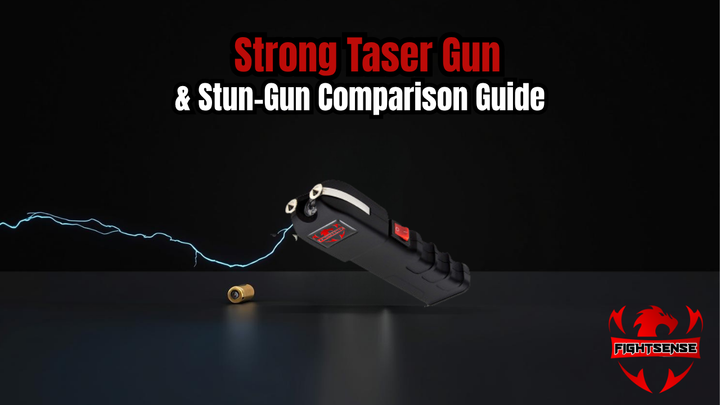
Strong Taser Gun & Stun‑Gun Comparison Guide
11th Nov 2025
In the year 2025, stun guns are becoming a more popular and safe way for people to protect themselves every day. This video talks about the different kinds of stun guns, how strong a strong taser gun really is, and how to safely pick one out, carry it, and use it.
FightSense makes stun guns for real people. They are designed to be comfortable to use and have safety features that make it acceptable to own and use them. This guide only talks about the facts about stun guns, like how to use them safely, and what the law and medicine say about them.
Keynotes
- A strong taser gun is judged by delivered energy under realistic conditions, electrode design, and deployment reliability.
- Stun guns offer a practical, low‑maintenance option for civilian daily carry when chosen and used responsibly.
- FightSense emphasizes ergonomic design, safety locks, and tested electrode layouts for dependable performance.
- Legal knowledge, secure storage, and routine training are non‑negotiable parts of responsible ownership.
- Select devices based on practicality and readiness metrics rather than headline voltage numbers.
Why Technical Metrics Matter
A stun gun sends a pulse with a lot of voltage and not much current to its target. This pulse works its way through metal plates. Your muscles hurt and feel weird for a short time because of that pulse. This gives you time to get away.
Most of the time, when people ask how strong tasers are, they only look at the voltage. Voltage alone may not tell the whole story. How well the technology really works rests on what it does for the body in real life.
Key technical points:
- Delivered energy vs. open‑circuit voltage: It's more important that the body gets energy than that the title says it has.
- Electrode spacing & shape: Electrodes that are wider and better shaped work better and hit more muscle.
- Pulse duration & repetition: Controlled pulses rest the body for a short time without putting it through too much.
- Circuit reliability & safety: Strong electronics and safety switches keep things from breaking down or turning on by accident.
Not only do these simple numbers show how strong tasers are on paper, but they also show how strong they are when you need to protect yourself in real life.
Stun Gun vs. Projectile Devices: Direct Comparison
Check out the range, reliability, upkeep, and legal status of stun guns and projectile weapons to help you make your choice.
Quick bullets — the big differences:
- Range: Stun guns need to be close to their target to work, but projectile weapons can hit from far away.
- Reliability: Stun guns have fewer parts to fail; projectile systems use cartridges and more moving parts.
- Regulation: Most of the time, stun guns have less strict rules than weapon systems.
- Concealability: Most of the time, stun guns are smaller and easier to hide than other guns.
Table — Quick comparison
|
Feature |
Stun Gun (contact) |
Projectile Device |
|
Range |
Contact only |
Several feet |
|
Mechanical complexity |
Low |
Higher |
|
Maintenance |
Low |
Higher (cartridges) |
|
Concealability |
Very high |
Moderate |
|
Typical legal burden |
Lower |
Higher |
If daily carry, low maintenance, and concealability matter most, a well‑made stun gun is usually the practical choice.
FightSense Stun Guns: Design & Real‑World Value
FightSense makes stun guns that work well, are safe to own, and are easy to carry. Not only are the specs taken into account, but also how the ideas will be used in real life.
Representative FightSense categories:
- Pocket / Everyday Stun: The phone is small, light, and charges quickly with USB-C, making it great for travelers.
- Grip / Utility Stun: As the name suggests, this stun gun is good for use at night because it has bigger wires, a textured grip, and an LED light.
- Tactical / Pro Stun: It has a training setting, a long battery life, and a case that is waterproof.
- Accessory / Discreet Stun: It has a fast-draw clip that makes it look like an accessory, so you can take it around without anyone noticing.
Many buyers ask how powerful are tasers, but the key question is whether the device delivers consistent incapacitation in real use. FightSense focuses on electrode layout, dependable circuitry, and safety interlocks to do exactly that.
Selection Checklist, Testing & Maintenance
Don't choose a stun gun based on how cool it looks; choose one that is ready to use.
Buying checklist (simple):
- Check how much room there is between the electrodes and how well the build was done.
- Pick units that can be charged and show you how much power they have left.
- Make sure the safety switch keeps the fire from starting by accident but still lets you use it quickly.
- For everyday use, choose a bag that is strong and can handle water.
- Get clear instructions and things to help you learn.
Testing & maintenance (practical):
- Every month, check the safety and battery lights.
- If the maker tells you to, do live tests every three months as they say to.
- Note the date, the amount of power left in the battery, and a short note about the function.
- Get new leads or other parts right away if any of them are worn out or broken.
Table — Readiness metrics
|
Metric |
Compact Pocket |
Grip / Tactical |
|
Deployment speed |
Very good |
Excellent |
|
Contact reliability |
Good |
Very good |
|
Maintenance needs |
Low |
Moderate |
|
Suitability for daily carry |
High |
High (if size acceptable) |
These simple checks keep your strong taser gun reliable and ready, and stop you relying on marketing claims alone.
Legal Rights, Responsible Use & Medical Cautions
Know the Law Before You Carry
- Laws are always changing, so before you buy or carry a stun gun, you should always check with your local government.
- Some places don't let you use or have rules about electroshock devices. This information can help you stay out of trouble with the law.
- Though you may own something, that doesn't mean you can use it whenever you want.
Where Not to Carry / Storage Rules
- Do not bring it into places that do not allow it, like schools, courthouses, some government buildings, and an awful lot of public transit systems.
- Make sure kids and other people who shouldn't have gadgets can't get to them.
- Turn off the device and hide it from other people if you don't know where you are.
Use‑of‑Force: When You Can Deploy
- If you are allowed to use a stun gun, you should only do so when it is legal and proper for the threat.
- You could get in trouble with the law if you use the device to scare, punish, or bother someone.
- For self-defense, you should call the cops right away and write down what happened (when, where, and who saw it).
Age, Eligibility & Transport
- Places will only let people of a certain age or with no past crimes own things. Before you buy it, make sure you can.
- There are different rules about stun guns in different places. Some say they can't be used in certain cars or on public transportation.
- Make sure you know the rules of both the place you're going and the company you're flying with so that your things don't get stolen or you get a ticket.
Training Essentials (practical)
- Draw & deploy drills: Do draw and deploy drills until the move feels natural and you can do it from where you normally carry your weapon.
- Grip retention: Practise on being able to keep a firm grip when things get tough.
- Targeting practice: Use inert training to get better at putting electrodes in the right places (for large muscle groups).
- Short, frequent training: Long sessions that don't happen very often are worse for growing skills than short sessions that happen often (10–15 minutes a week)
Myths vs Facts
- Myth: “Volts are everything.”
Truth: A device's efficiency relies on how much current it sends, how good the contact is, and how the pulse is shaped.
- Myth: That "small stun guns don't work" is not true.
Truth: Small models that are well-made can work pretty well for meetings that are close together.
- Myth: "Having a stun gun makes you immune to the law."
Truth: Just because you own something doesn't mean you can use it whenever you want; you need a legal reason to do so.
Conclusion
A strong taser gun is a practical defensive option when built and used responsibly. Good stun guns are usually the best choice for people who want an easy-to-hide and care-for stun gun that can really stop someone.
FightSense's main goal is to make devices that can keep you connected, keep you safe, and handle power well so you can carry them with ease. Remember that being responsible means learning the law, using your gear in a smart and safe way, and getting training every so often.
Disclaimer
This information is not meant to give you legal, medical, or military advice. Laws and rules change over time, so make sure you know what the rules are where you live before you buy, carry, or use a stun gun. Talk to a trained professional if you have questions about medicine or the law.
FAQs
Q1. How often should I test my strong taser gun?
Monthly functional checks and quarterly live tests (per manufacturer guidance) keep your device reliable.
Q2. How powerful are tasers in practical terms?
Practical power depends on delivered energy under load, electrode gap, and pulse design — not just open‑circuit volts.
Q3. How powerful is a taser compared to a stun gun?
Projectile tasers project probes and can create distance; stun guns require contact and are simpler and often more reliable for daily carry.
Q4. Can I use a strong taser gun on anyone who threatens me?
Use must be proportional and legally justified. Misuse can result in criminal or civil liability.
Q5. Are FightSense stun guns legal?
FightSense builds devices with lawful ownership in mind; verify local rules before purchase or carry.